


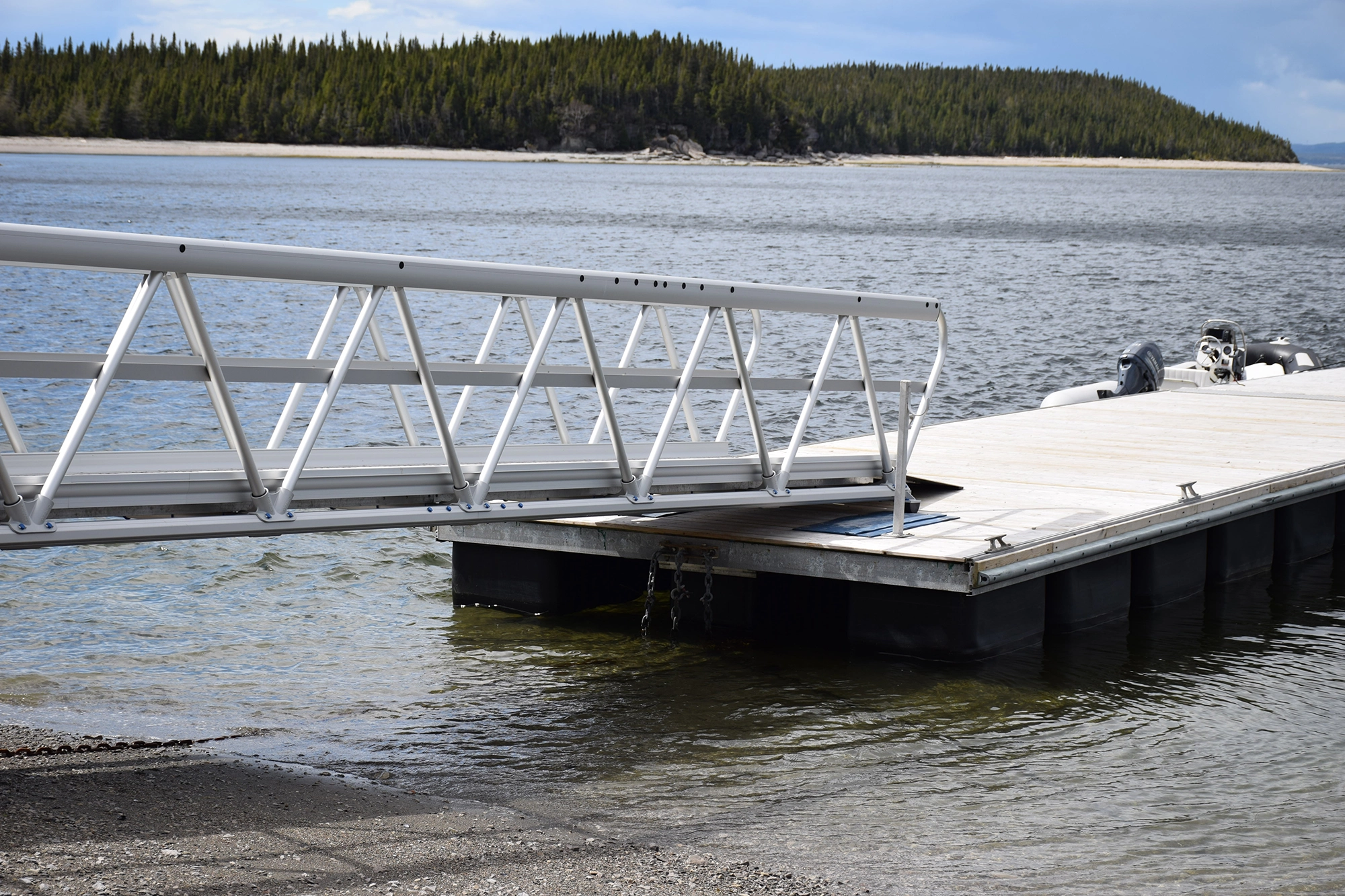
Marine-grade aluminum refers to aluminum alloys selected for their corrosion resistance, mechanical properties, and suitability for exposure to seawater, salt spray, and coastal environments. The most widely used alloys belong to the 5xxx (aluminum-magnesium) and 6xxx (aluminum-magnesium-silicon) series.
But what makes an aluminum alloy suitable for marine applications? Which alloys are commonly specified, and what do temper designations such as H116 and T6 actually mean?
In this guide, you'll learn:
- What defines marine-grade aluminum and which standards apply to its selection and use.
- How common 5xxx and 6xxx marine aluminum alloys differ in composition, corrosion resistance, strength, and temper.
- Where aluminum sheet, plate, and extrusions are used in floating docks, marine gangways, pedestrian bridges, vessels and other waterfront structures.
- How marine-grade aluminum compares with conventional aluminum alloys, carbon steel, and stainless steel.
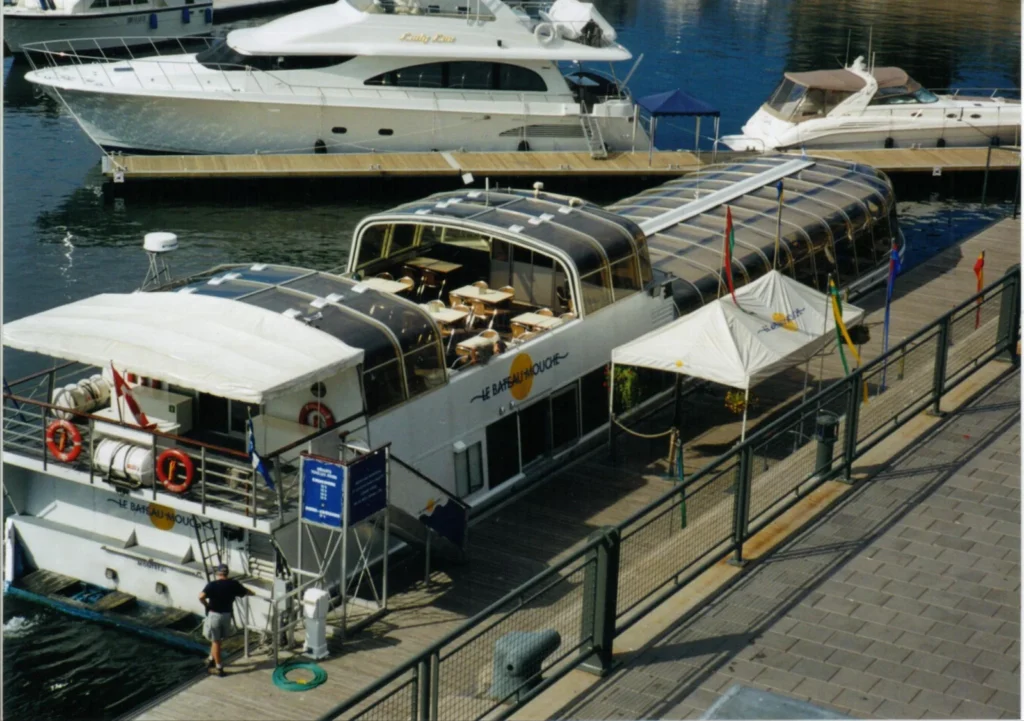
What Makes an Aluminum Alloy Marine Grade?
Marine-grade aluminum is not a single alloy or a universal material classification. The term generally refers to aluminum alloys selected for their corrosion resistance, mechanical properties, and suitability for marine environments. The appropriate alloy depends on whether the component is exposed to salt-laden air, seawater spray, intermittent wetting, or permanent immersion.
Aluminum alloys are classified into series according to their principal alloying elements. The 5xxx (aluminum-magnesium) and 6xxx (aluminum-magnesium-silicon) series are widely used in marine structures, but they serve different purposes.
5xxx series — seawater resistance and welded plate structures. Magnesium provides strength without requiring heat treatment. Alloys such as 5083, 5086, and 5383, particularly in marine tempers such as H116 and H321, offer excellent seawater corrosion resistance and weldability. They are well suited to welded hulls, submerged components, and marine plate structures. Other 5xxx alloys, including 5454 and 5456, are used where their specific mechanical and corrosion properties meet the application requirements.
6xxx series — structural extrusions and marine infrastructure. Magnesium and silicon form magnesium silicide (Mg₂Si), enabling strengthening through heat treatment. Alloys such as 6061, 6005A, and 6082 combine structural strength, good corrosion resistance, and excellent extrudability. They are particularly useful for floating docks, gangways, bridge decks, and pedestrian bridges. However, their suitability for direct seawater contact must be assessed separately, especially for permanently submerged components.
Other aluminum series, including many 2xxx and high-strength 7xxx alloys, may offer higher mechanical strength but generally require greater attention to corrosion protection and fusion weldability in marine applications.
Ultimately, selecting marine-grade aluminum requires evaluating alloy composition, temper, product form, structural performance, weldability, and seawater exposure, together with applicable material and design standards.
For a closer look at corrosion mechanisms and long-term performance, read our guide to aluminum corrosion resistance and durability.
Marine Aluminum Standards and Classification Rules
There is no single certification or universal specification that defines an aluminum alloy as "marine grade." Instead, suitability depends on the alloy, temper, product form, intended application, and applicable marine standards.
- ASTM B928/B928M, Standard Specification for High Magnesium Aluminum-Alloy Sheet and Plate for Marine Service and Similar Environments, establishes requirements for selected high-magnesium aluminum alloy sheet and plate intended for marine service. It includes requirements addressing resistance to exfoliation and intergranular corrosion, particularly important for alloys exposed to seawater.
- IACS Unified Requirement W25, Aluminium Alloys for Hull Construction and Marine Structure (Rev.6, September 2021), establishes requirements for aluminum alloys used in classed ships and marine structures. It covers rolled sheet and plate in 5xxx alloys such as 5083, 5086, 5383, 5059, 5754, and 5456, as well as extruded structural products in 6xxx alloys such as 6005A, 6061, and 6082, subject to the specified tempers and product requirements. An important distinction concerns direct seawater exposure. Under IACS W25, 6005A and 6061 aluminum alloys should not be used in direct contact with seawater unless protected by sacrificial anodes and/or a suitable protective coating system. Consequently, for continuously submerged marine components, appropriately specified 5xxx-series alloys are generally preferred, while 6xxx-series alloys are commonly used for structural extrusions above the waterline, including gangways, access structures, and pedestrian bridges.
The 5xxx Series of Marine Aluminum Alloys
The 5xxx-series aluminum alloys are non-heat-treatable, meaning their strength cannot be increased through precipitation heat treatment. Instead, they derive their strength primarily from magnesium alloying and can be further strengthened through cold working (strain hardening), identified by H temper designations.
According to the Aluminum Association, these alloys offer moderate to high strength, good weldability, and excellent corrosion resistance in marine environments. They are widely used in shipbuilding and marine fabrication, particularly for rolled sheet and plate components exposed to seawater.
For demanding marine applications, specific tempers such as H116 and H321 are used to meet additional requirements for resistance to exfoliation and intergranular corrosion. The annealed O temper is also available where greater formability is required.
5083 and 5383 Aluminum Plate
5083 aluminum is one of the most widely specified alloys for welded ship hulls and marine structures. It combines high strength, excellent seawater corrosion resistance, and good weldability. It is also used in welded pressure vessels. For marine service, 5083 plate is commonly specified in H116 or H321 temper to meet additional corrosion-resistance requirements.
5383 aluminum, commercially known as Sealium® in Constellium's product range, is an optimized aluminum-magnesium alloy developed for demanding marine applications. Available in rolled plate and sheet as well as certain extruded products, it offers higher mechanical strength than conventional 5083, including improved strength performance in welded structures. This makes it particularly attractive for weight-sensitive marine applications where structural efficiency and weldability are important.
5086, 5456, 5059 and 5754 Aluminum Alloys
5086 aluminum offers slightly lower strength than 5083 while maintaining excellent seawater corrosion resistance and good weldability. It is widely used in welded marine structures, including boat hulls, decks, and other components exposed to saltwater.
5456 aluminum is a high-strength aluminum-magnesium alloy used in welded marine structures, including shipbuilding applications and storage tanks. Its relatively high magnesium content provides increased strength but requires careful consideration of temper and service conditions to manage susceptibility to sensitization and intergranular corrosion.
5059 aluminum is among the highest-strength 5xxx-series alloys specified for marine plate applications under IACS classification requirements. It offers excellent mechanical performance, weldability, and corrosion resistance, making it suitable for demanding, weight-sensitive marine structures.
5754 aluminum provides good corrosion resistance, weldability, and formability, although its mechanical strength is lower than that of 5083, 5456, and 5059. It is commonly used for formed sheet-metal components and marine applications where fabrication versatility is more important than maximum structural strength.
5052 Aluminum for Lighter Marine Applications
5052 aluminum is widely used in small boats, recreational watercraft, and fabricated marine components because of its excellent formability, good weldability, and corrosion resistance. It is commonly available in strain-hardened tempers such as 5052-H32, making it particularly suitable for bent and formed sheet-metal components.
Although 5052 performs well in many marine environments, it is not among the alloys specified under IACS Unified Requirement W25 for classified ship hull construction. For more demanding welded marine structures, particularly those exposed to seawater, engineers commonly specify higher-strength alloys such as 5083 or 5086 in appropriate marine tempers.
However, 5083 and 5086 sheet and plate can be less readily available through general-purpose aluminum distributors than 5052, often requiring procurement from specialized marine aluminum suppliers. Availability may vary significantly by region, thickness, temper, and product dimensions.
The 6xxx Series in Marine Aluminum Extrusions
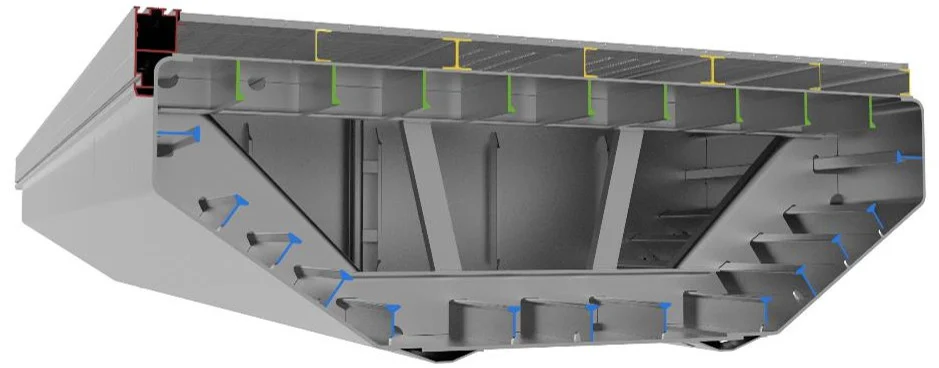
The 6xxx-series aluminum alloys are heat-treatable and particularly well suited to extrusion. According to the Aluminum Association, they are widely preferred for architectural and structural applications because they combine strength, corrosion resistance, weldability, and excellent extrudability.
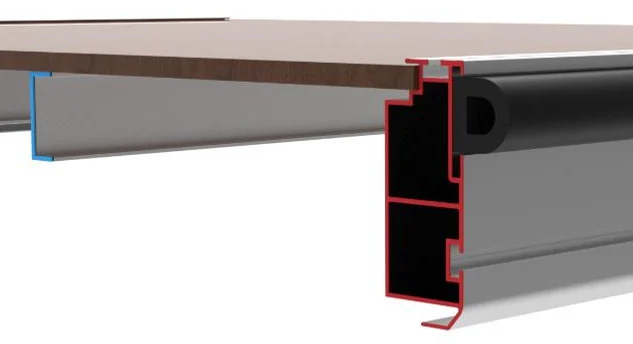
One of their greatest advantages is the ability to manufacture complex, one-piece structural profiles, including hollow truss chords, multi-chamber sections, integrated deck channels, and custom structural shapes. These extrusions can reduce the number of individual components, mechanical connections, and fabrication operations required.
Common 6xxx alloys used in marine and waterfront structures include:
- 6061-T6: A versatile structural alloy widely used for aluminum frames, vessels, trusses, bridge chords, gangways, and floating dock structures. It offers a good balance of mechanical strength, corrosion resistance, weldability, and availability.
- 6005A-T6: A structural extrusion alloy offering good strength and extrudability, particularly suitable for complex profiles and welded assemblies. It is also recognized under IACS requirements for certain marine structural applications.
- 6082-T6: A higher-strength structural alloy commonly used in European marine and civil engineering applications. It generally provides higher minimum mechanical strength than 6061-T6 and 6005A-T6 for comparable product conditions, although its extrudability can be more limited for complex shapes.
- 6063: Primarily an architectural extrusion alloy used for handrails, railings, trim, and other components requiring good surface finish and anodizing quality. It is not among the structural extrusion alloys listed in IACS Unified Requirement W25.
Welding considerations: Welding heat-treatable 6xxx alloys typically reduces their mechanical strength in the heat-affected zone (HAZ). Structural design must therefore account for reduced as-welded properties rather than relying solely on the nominal T6 strength. Mechanically fastened connections can avoid this welding-related loss of temper, making them particularly advantageous in modular aluminum structural systems.
Aluminum Alloy Tempers: H116, H321 and T6
An aluminum alloy's temper designation identifies its metallurgical condition and how its mechanical properties were developed. Temper selection is as important as alloy selection when specifying aluminum for marine and waterfront structures.
- O (annealed): A softened condition providing high ductility and formability.
- H32 (strain-hardened and stabilized): A quarter-hard temper commonly used for formed aluminum sheet components.
- H116 and H321 (marine tempers): Specially controlled conditions for selected 5xxx-series alloys intended for marine service. Applicable specifications include requirements for resistance to exfoliation and intergranular corrosion, evaluated using ASTM G66 and ASTM G67.
- T5 (cooled from an elevated-temperature shaping process and artificially aged): A heat-treated temper commonly used for structural aluminum extrusions.
- T6 (solution heat-treated and artificially aged): A high-strength temper widely specified for structural aluminum extrusions, including 6061-T6, 6005A-T6, and 6082-T6.
- T61 (variation of T6): A specific heat-treatment condition with mechanical properties that may differ from those of T6. The two designations should not be treated as interchangeable without verifying the applicable material specification.
Under IACS UR W25, an M suffix identifies applicable 5xxx-series products that have satisfied the specified corrosion-testing requirements, such as 5083-H321 M.
Minimum Mechanical Properties of Common Marine Aluminum Alloys
| Alloy-temper | Series | Typical product form | Min. yield / tensile (MPa) |
|---|---|---|---|
| 5083-H116 | 5xxx | Rolled plate | 215 / 305 |
| 5383-H116 | 5xxx | Rolled plate | 220 / 305 |
| 5086-H116 | 5xxx | Rolled plate | 195 / 275 |
| 6061-T6 | 6xxx | Extrusion | 240 / 260 |
| 6082-T6 | 6xxx | Extrusion, >5–50 mm | 260 / 310 |
| 6005A-T6 | 6xxx | Extrusion, 3–10 mm | 215 / 260 |
Minimum 0.2% proof stress (yield strength) and ultimate tensile strength, expressed in MPa, based on IACS UR W25 Rev.6. Values depend on alloy, temper, product form, and thickness. The applicable material specification should always be consulted for engineering design.
Technical note — 6005A-T6 vs. 6005A-T61: IACS UR W25 specifies minimum yield and tensile strengths of 215 / 260 MPa for 6005A-T6 extrusions with thicknesses from 3 to 10 mm, decreasing to 200 / 250 MPa for thicknesses above 10 mm and up to 50 mm. By comparison, the Aluminum Association's Aluminum Design Manual (ADM) 2020, Table A.4.3, lists nominal strengths of 35 ksi (approximately 240 MPa) yield and 38 ksi (approximately 260 MPa) tensile for 6005A-T61 extrusions under ASTM B221. These values apply to a different temper designation and should not be substituted for the IACS 6005A-T6 requirements without verifying the governing specification.
Engineering consideration: The values shown represent minimum base-material mechanical properties, not allowable design stresses. Welding can reduce the strength of strain-hardened 5xxx alloys and heat-treated 6xxx alloys within the heat-affected zone (HAZ). Structural calculations must account for the applicable as-welded properties and the requirements of the governing design standard, such as CSA S157 or the Aluminum Design Manual.
Marine Aluminum Alloys by Exposure Zone and Structural Application
Marine and waterfront structures often combine different aluminum alloy families, including wrought 5xxx and 6xxx alloys and casting alloys such as 356 and 357. Material selection depends on the exposure environment, structural loads, fabrication method, and applicable design standards.
Each structural component requires an alloy and temper suited to its mechanical demands and exposure conditions, whether submerged, exposed to wave splash, or located above the waterline.
Submerged Members: 5xxx Aluminum Plate
The 5xxx series is widely used for marine components exposed to continuous immersion, particularly welded plate structures requiring good seawater corrosion resistance.
For example, the submerged structural components of a MAADI Group floating wave attenuator incorporate 5083 and 5086 aluminum plates, selected for their combination of corrosion resistance, strength, and weldability.
Selecting the appropriate alloy is especially important in continuously wetted environments. As discussed in our aluminum corrosion resistance guide, inappropriate material selection can contribute to premature corrosion and component failure.
Bridge Decks, Docks and Gangways: 6xxx Aluminum Extrusions
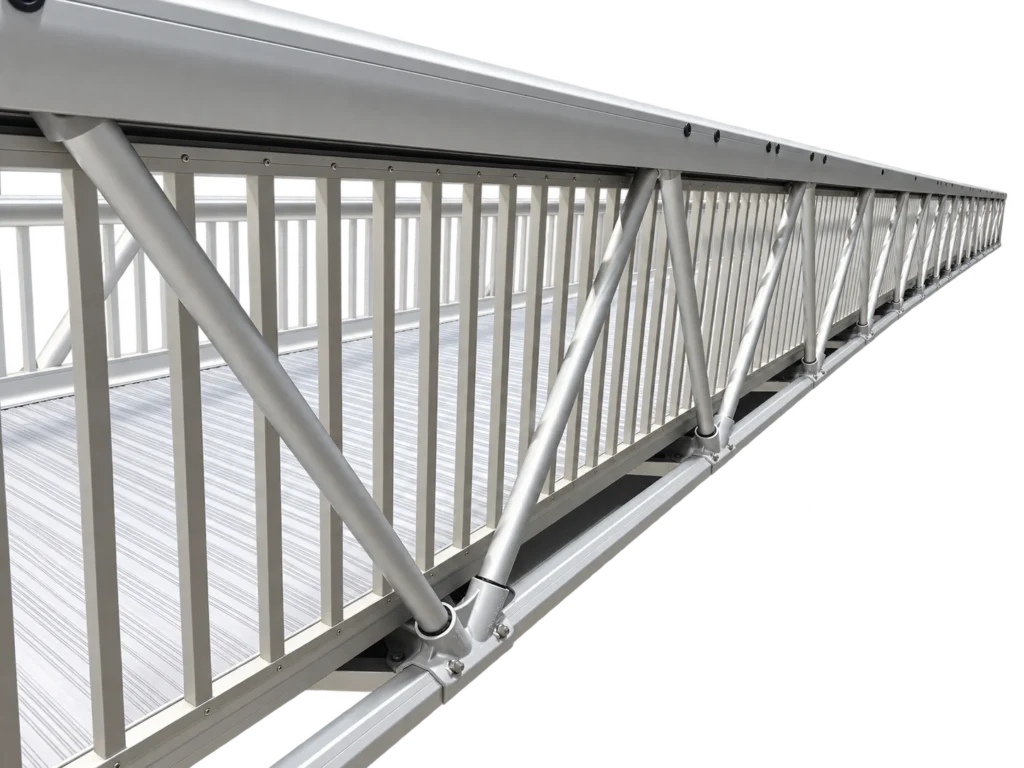
The 6xxx-series aluminum alloys are widely used in structural bridge decking, floating docks, marine gangways, and waterfront access structures. Their excellent extrudability allows engineers to develop complex profiles with integrated stiffeners, hollow sections, and connection features, reducing the number of separate components and fabrication operations.
MAADI Group uses custom 6000-series aluminum extrusions in its structural bridge decking systems, floating wave attenuators, and aluminum floating docks. These profiles combine lightweight construction, structural efficiency, and good corrosion resistance in marine and coastal environments.
Marine gangways also commonly incorporate welded 6xxx-series structural extrusions, particularly 6061-T6 and 6005A-series alloys. Where welding is required, structural calculations must account for reduced mechanical properties in the heat-affected zone.
Surface finish is another consideration for exposed aluminum structures. Our comparison of clear anodized and mill finish aluminum gangways explains how these finishes differ in appearance, corrosion resistance, and structural considerations.
Pedestrian Bridges: Structural Extrusions and Aluminum Castings
Prefabricated aluminum pedestrian bridges can combine extruded structural members with engineered aluminum castings and stainless steel fasteners.
For example, MAADI Group's LVTB-1811 lightweight aluminum bridge incorporates 6005A-T61 and 6061-T6 structural extrusions, AA356-T6 or AA357-T6 aluminum castings, and 300-series stainless steel fasteners.
The LVTB-2418 modular bridge uses a similar combination of materials and is engineered in accordance with applicable structural design standards, including the Aluminum Design Manual.
This combination illustrates how extruded and cast aluminum components can be integrated into lightweight, modular structural systems while meeting different strength, connection, and fabrication requirements.
Marine Aluminum vs. Other Metals
Compared with general-purpose aluminum alloys, marine-grade aluminum is distinguished by its alloy composition, corrosion resistance, mechanical properties, and suitability for the intended exposure conditions. While 3xxx-series alloys primarily use manganese and 7xxx-series alloys rely on zinc as a principal alloying element, the marine applications covered by IACS UR W25 focus on selected 5xxx and 6xxx alloys.
Compared with carbon steel, aluminum weighs approximately one-third as much for the same volume and develops a naturally protective oxide layer, eliminating the need for galvanizing and often reducing coating-related maintenance. In studies conducted with Polytechnique Montréal, MAADI Group identified an average degradation period of approximately 33 years for hot-dip galvanized steel under the urban exposure conditions evaluated. Actual service life varies with environmental conditions, coating thickness, and maintenance.
Stainless steel fasteners are commonly used in aluminum marine structures, but direct electrical contact in the presence of seawater can create a galvanic corrosion risk, with aluminum acting as the less noble metal. Depending on the exposure conditions, appropriate detailing may include dielectric isolation, compatible washers, sealants, and drainage provisions to minimize moisture retention. For certain immersed structures, properly designed sacrificial anode systems provide additional corrosion protection.
Well-designed marine aluminum structures can achieve service lives of several decades, potentially 30 to 50 years or longer depending on the application, environment, and maintenance. Their low weight, corrosion resistance, and reduced coating requirements can contribute to a lower total cost of ownership compared with steel.
Selecting the right marine aluminum requires more than choosing an alloy number: temper, product specification, material certification, and exposure conditions all matter.
Specifying Aluminum Alloys for Marine Structures
Specify the alloy, temper, product form, and applicable material standard, rather than relying on the general designation "marine-grade aluminum."
For submerged welded plate structures, consider 5083 or 5086 in H116 or H321 temper where ASTM B928 or marine classification requirements apply. For structural extrusions used in floating docks, gangways, bridge decks, and pedestrian bridges, common choices include 6061-T6, 6005A-T6, and 6005A-T61, subject to the governing material specifications and exposure conditions.
Where stainless steel fasteners are used, assess galvanic corrosion risks and specify appropriate isolation, sealing, or drainage details as required. Components exposed to direct seawater contact may require additional protective measures.
Request a mill test certificate (MTC) with each material delivery to verify alloy designation, temper, chemical composition, mechanical properties, and traceability. For marine-grade 5xxx plate subject to classification rules, confirm compliance with the applicable corrosion-testing requirements and the M suffix designation where required by IACS UR W25.
Proper material specification helps ensure that the selected aluminum components meet the structural, corrosion-resistance, fabrication, and service-life requirements of the marine application.
Talk to our engineers about alloy selection
Our engineers specify the alloy, temper and finish of every member on the aluminum docks, gangways and bridges we design.
Request a QuoteFAQ: Marine-Grade Aluminum
Is 6061 Aluminum Marine Grade?
Yes. 6061-T6 is widely used in marine and waterfront structures, including floating docks, gangways, pedestrian bridges, frames, and railings. This heat-treatable 6xxx-series alloy offers a good combination of strength, corrosion resistance, weldability, and extrudability.
6061-T6 is recognized under IACS UR W25 for certain marine structural extrusions. However, direct seawater contact requires appropriate corrosion protection under these classification rules. For welded plate structures exposed to permanent seawater immersion, 5xxx-series alloys such as 5083-H116 and 5086-H116 are generally preferred.
Is 5052 Aluminum Good for Salt Water?
Yes. 5052 aluminum offers good saltwater corrosion resistance and is commonly used in small boats, recreational watercraft, and formed sheet-metal components. However, its mechanical strength is lower than that of higher-strength marine alloys such as 5083 and 5086.
According to the Aluminum Association's Aluminum Design Manual (ADM) 2020, 5052-H32 has a nominal yield strength of 159 MPa and an ultimate tensile strength of 214 MPa, compared with 214 / 303 MPa for 5083-H116 and 193 / 276 MPa for 5086-H116, respectively, for the applicable product thicknesses.
Although 5052 is suitable for many marine applications, it is not listed under IACS UR W25 for classified hull construction. For demanding welded hulls and submerged structural components, 5083-H116 and 5086-H116 are generally preferred because of their higher strength and marine-service qualifications.
What Is the Best Marine-Grade Aluminum Alloy?
There is no single best marine-grade aluminum alloy. The optimal choice depends on structural loads, seawater exposure, fabrication methods, and applicable design standards.
For welded hulls and permanently submerged structures, 5083-H116, 5086-H116, and 5383-H116 offer excellent seawater corrosion resistance, good weldability, and high strength. These 5xxx alloys are particularly well suited to direct seawater contact, with appropriate marine tempers subject to specific corrosion-resistance requirements.
For floating docks, gangways, bridge decks, and pedestrian bridges, structural extrusions such as 6061-T6, 6005A-T6/T61, and 6082-T6 provide strength, design flexibility, and good atmospheric corrosion resistance. However, 6061 and 6005A are not normally acceptable for unprotected direct seawater contact under Lloyd’s Register's 2017 material rules.
For modular bridge connections, 356-T6 and 357-T6 aluminum castings can complement structural extrusions.
Ultimately, the best alloy is the one selected for each component's structural requirements, exposure conditions, and applicable material standards.
What Does H116 Mean on Aluminum Plate?
H116 is a special temper designation for selected 5xxx-series aluminum alloys intended for marine service, including 5083 and 5086. It identifies material produced to specified mechanical properties and corrosion-resistance requirements, particularly resistance to exfoliation and intergranular corrosion.
Unlike conventional strain-hardened tempers, H116 is defined by specific property and corrosion-performance requirements rather than a single prescribed processing sequence.
ASTM B928/B928M establishes requirements for marine-grade aluminum sheet and plate, including applicable corrosion testing under ASTM G66 and ASTM G67.
Under IACS UR W25, qualifying marine aluminum plate is subject to specified corrosion-testing requirements and may carry an M suffix after the temper designation, such as 5083-H116 M, to identify compliance with the applicable classification requirements.
Is Marine-Grade Aluminum Stronger Than Steel?
Not necessarily in absolute strength, but marine-grade aluminum offers a superior strength-to-weight ratio compared with conventional structural carbon steel.
Aluminum weighs approximately one-third as much as steel for the same volume (2,700 vs. 7,850 kg/m³). For example, 6061-T6 aluminum has a minimum yield strength of 240 MPa, comparable to ASTM A36 structural steel at 250 MPa, despite its significantly lower density. This gives 6061-T6 approximately 2.8 times the yield strength per unit weight of ASTM A36 steel.
Although steel has a higher ultimate tensile strength and elastic modulus, properly engineered aluminum structures can achieve comparable load-carrying capacity with substantially less weight, depending on structural design requirements.
For floating docks, marine gangways, and pedestrian bridges, this translates into lighter structures, reduced dead loads, easier installation, and potentially lower long-term maintenance costs.
Does Marine-Grade Aluminum Corrode in Salt Water?
Marine-grade aluminum alloys such as 5083 and 5086 offer excellent resistance to seawater corrosion and have demonstrated decades of successful marine service. Their naturally forming protective oxide layer limits general corrosion, although localized pitting may occur.
Alloy selection is critical. Lloyd’s Register requires specific exfoliation and intergranular corrosion-resistance testing for designated 5xxx-H116/H321 alloys used in marine hull construction or applications involving frequent seawater contact. By contrast, its 2017 material rules identify 6061 and 6005A as not normally acceptable for direct seawater contact.
Properly selected 5xxx alloys can provide outstanding durability without relying solely on protective coatings. However, additional corrosion protection may be necessary depending on the application, exposure conditions, and applicable classification requirements, particularly for seagoing vessels.
Can Marine-Grade Aluminum Be Welded?
Yes. Both 5xxx and 6xxx marine-grade aluminum alloys are weldable, commonly using MIG (GMAW) or TIG (GTAW) processes. However, fusion welding can significantly reduce yield strength in the heat-affected zone (HAZ), particularly for heat-treated 6xxx alloys such as 6061-T6.
5083, 5086, and 5383 offer excellent weldability, with 5383 developed for improved as-welded strength. Filler metal selection also matters: ER5183 and ER5556 are used for high-strength marine weldments, while ER5356 generally provides higher weld-metal strength than ER4043 when welding 6061-T6.
Alternative processes such as friction stir welding (FSW) and laser beam welding (LBW) can reduce heat-affected zone (HAZ) degradation compared with conventional fusion welding, depending on the alloy and welding parameters. Structural design must account for applicable welded and HAZ properties, while fabrication must follow qualified procedures and relevant welding standards.


