



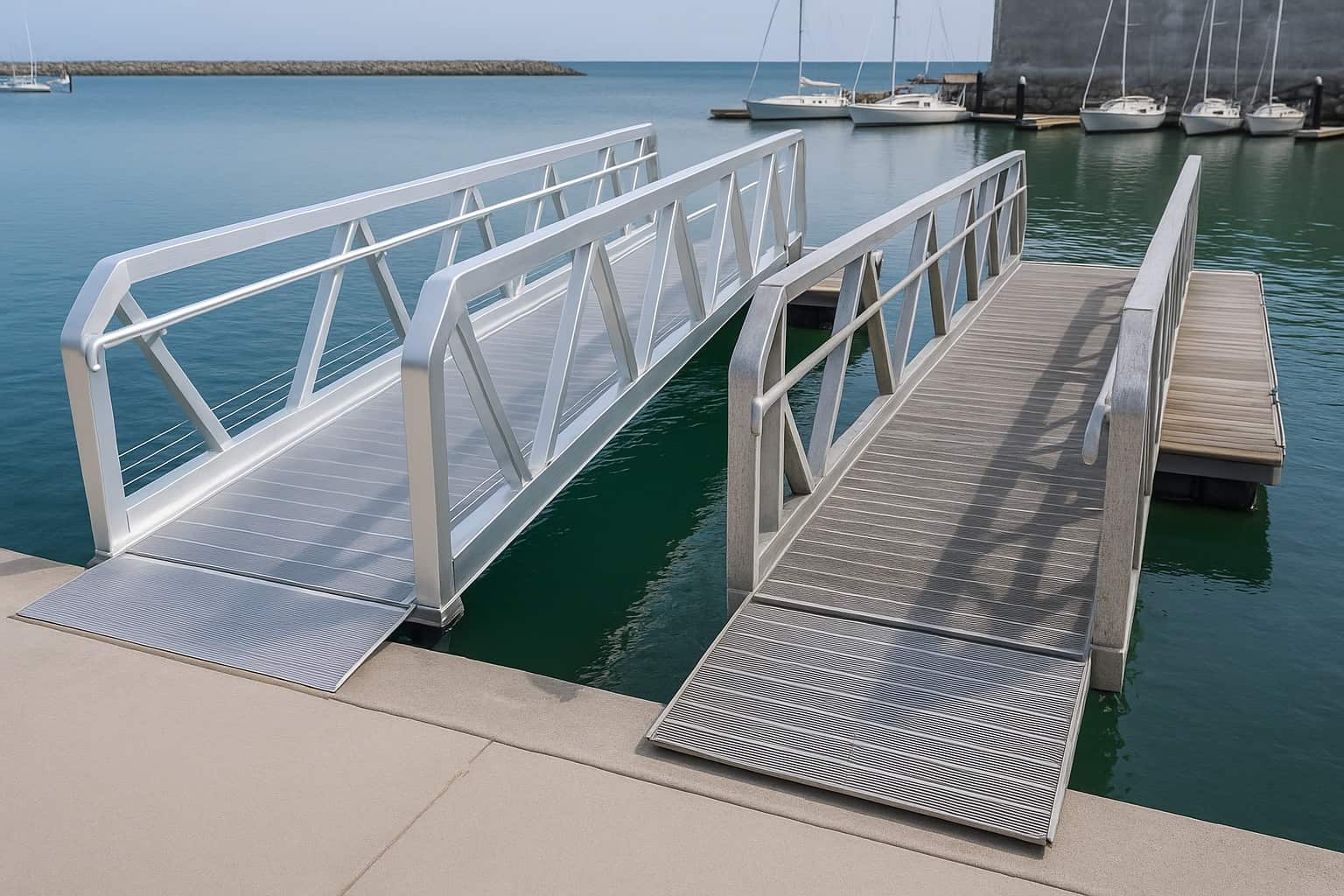
In marinas, ports, and waterfront developments, aluminum gangways have become the dominant choice for connecting land to floating docks. Their success is driven by two fundamental advantages: light weight and an exceptional life-cycle performance, far superior to steel in corrosive marine environments.
For more than a century, aluminum has proven its durability thanks to its natural corrosion-resistant mechanism. When exposed to air and moisture, aluminum forms a thin, protective oxide layer that prevents deeper corrosion—similar to how copper develops a green patina over several decades.
However, this natural oxidation has aesthetic limitations. Over time, mill-finish aluminum becomes dull and dark grey, often developing white, localized pitting; a common form of cosmetic corrosion in salty or polluted atmospheres. While the structure typically remains sound, its appearance can quickly look aged or neglected.
This is where many marina designers unintentionally compromise visual quality. To reduce cost, projects often default to the most inexpensive option, even though the gangway is the first structure visitors see when entering a marina or offshore facility.
Aluminum is indeed an exceptional material for marine settings, but the finish and the type of extrusion system selected have a major impact on:
- Long-term corrosion resistance
- Structural performance and durability
- Visitor perception, architectural quality, and overall visual appeal
In today’s market, two aluminum finishes dominate waterfront infrastructure:
- Mill-finish aluminum (raw, uncoated)
- Clear anodized aluminum
Understanding how these two finishes behave over time—and how extrusion design influences aesthetics and lifespan—is essential for anyone designing or operating a marina.
These two options may look similar when new—especially when clear anodizing is chosen—but in coastal marine environments, the long-term difference becomes dramatic.
This guide explains the real-world differences between the two finishes, how they age, and why the extrusion system used (proprietary vs. off-the-shelf profiles) matters as much as the finish itself.


1. Mill Finish Marine Gangways: The Standard Choice — and Its Limitations
Mill finish aluminum is widely used in North America, Europe, Asia, and the Middle East because it is:
- Affordable
- Easy to source (off-the-shelf profiles)
- Mechanically corrosion-resistant

But it has two major drawbacks in marine environments.
- Oxidation: The Loss of Aesthetic Quality

Mill finish aluminum oxidizes quickly in coastal conditions. While aluminum doesn’t rust like steel, it forms a grey, chalky, uneven oxide layer.
Mill finish oxidation is accelerated by:
- UV exposure
- Salt-laden air
- High humidity and heat
- Dust, urban pollution, and fine sand
This results in a finish that:
- Looks dull, mottled, or chalky
- Shows stains and dirt permanently
- Ages unevenly
- Rubs off on hands and clothing
Even when structurally sound, mill finish gangways can look 10–20 years older after only a few seasons in hot, salty, and humid marine environments.
- Pitting Corrosion: The Most Common Marine Degradation

The corrosion marked in the photos is pitting corrosion, combined with atmospheric oxidation—extremely common on mill finish aluminum.
Pitting presents as:
- Small round pits
- Cratered or rough texture
- Dark grey or black spots
- Localized surface degradation
Consequences include:
- Severe visual deterioration
- Premature “old” appearance
- Difficult or impossible cleaning
- Irreversible damage (requires sanding or refinishing)
Pitting is especially common on welded 6000-series alloys (typical for standard gangways).
It is usually cosmetic, unless extremely deep or combined with thin-walled extrusions.
How to Prevent This?
Best solution: Clear Anodizing
Clear anodizing:
- Creates a uniform sealed oxide layer
- Prevents pitting
- Prevents uneven oxidation
- Maintains a premium, architectural appearance for 50–100 years
This is why anodized aluminum dramatically outperforms mill finish in marinas, especially in warm, humid climates.
2. Clear Anodized Aluminum Gangways: The Premium Marine Finish
Clear anodizing produces a uniform, ultra-hard, corrosion-resistant surface that is:
- Highly resistant to marine corrosion
- UV-stable
- Easy to clean
- Long-lasting (50+ years)
- Consistent in color and sheen
Why anodizing performs so well in marine environments
It:
- Seals the aluminum surface
- Blocks pitting and staining
- Provides consistent architectural aesthetics
- Retains its appearance for decades
- Dramatically slows oxidation
Architectural Advantage
Anodizing produces a three-dimensional crystalline metallic finish that refracts light—something architects value for luxury setup such as marinas and high-end waterfronts.
Type II Architectural Anodizing (Marine Standard)
- Thickness: 10–25 microns (0.00039″–0.00098″)
- Qualanod: minimum 15 microns recommended for outdoor use
- Common colors: clear, champagne, bronze, black
- Clear anodizing is recommended when scratches may occur (unlike dark anodizing, scratches reveal bright metal)
Benefits when used with proprietary marine extrusions:
- Rounded edges, fewer oxidation-prone sharp corners
- Architectural shapes (not industrial HSS tubes)
- Reduced welding (avoiding heat-affected soft zones)
- Integration of features such as lighting, stiffeners, attachment channels, and more
3. Proprietary Marine Extrusions vs. Off-the-Shelf Profiles: The Overlooked Factor
Beyond the surface finish, the extrusion design itself is one of the most important—and most overlooked—factors influencing the long-term value, structural performance, and visual quality of a gangway.
Unlike steel, which is restricted to rolled shapes (channels, angles, HSS tubes, and beams), aluminum can be precision-extruded into almost any geometry. This is especially true with 6000-series alloys, which dominate architectural and structural applications because they:
- Extrude easily into complex, multi-functional profiles
- Maintain excellent strength-to-weight performance
- Accept anodizing uniformly
- Allow tight dimensional tolerances
This is the same advantage that enables the curtain wall and façade industry to rely almost exclusively on aluminum. Architectural extrusions commonly integrate:
- Grooves and channels
- Attachment points
- Hidden fastener cavities
- Port holes for wiring
- Tracks for gaskets or thermal breaks
These features simply cannot be achieved with traditional rolled steel shapes.
Why Many Gangways Still Use Basic Profiles
Despite the clear benefits of purpose-built extrusions, many gangways worldwide are still assembled using standard distributor profiles—angles, tees, tubes, channels, and flat bars originally designed for general industrial use.
This happens for two main reasons:
- Convenience: Engineers and fabricators default to shapes that are easily available from local suppliers.
- Legacy habits: Designs are often inspired by old steel-frame gangways rather than modern aluminum capabilities.
While these off-the-shelf profiles are structurally adequate, they are rarely:
- Optimized for weight
- Efficient in load distribution
- Visually refined
- Compatible with high-end anodized architectural finishes
The Result: A More Industrial Look
Standard welded assemblies made from generic profiles often produce a gangway that:
- Appears industrial instead of architectural
- Shows visible weld scars and heat-affected zones
- Lacks integrated features (channels, attachment points, lighting routes, etc.)
- Cannot be fully anodized due to large welded structures not fitting in tanks
- Ages poorly in premium marina environments
By contrast, purpose-built proprietary marine extrusions create lighter, stronger, cleaner, and more visually appealing gangways that align with modern waterfront architecture.
Off-the-Shelf Profiles (HSS, angles, tees, bars)
Advantages
- Readily available locally
- Lower manufacturing cost
- No limits on length or width of a welded gangway (sections can be welded together)
- Simpler to fabricate
- Suitable for basic, budget-driven projects
Drawbacks
- Industrial appearance
- Visible weld scars and discoloration
- Difficult to anodize because large, welded structures may not fit in anodizing tanks
- Susceptible to oxidation and pitting when mill finish
- Requires weld inspections for structural compliance
- Limited to distributor stock lengths (20’–24’)
- Higher shipping cost (cannot fit in closed crates)
- Lower perceived value in luxury developments
Common Example
Standard welded aluminum gangways using off-the-shelf profiles, often seen at the entrance of many marinas.


Proprietary, Purpose-Built Extrusion Systems for Marine Gangways
Benefits
- Clean, modern, sleek architectural lines
- Beautiful anodized finish free of weld discoloration and distortion post welding
- Integrated channels, stiffeners, and non-slip surfaces
- Reduced long-term maintenance (pressure wash every few years – looks bran new)
- Higher real-estate value perception for marinas
- Shippable unassembled in compact crates inside dry containers
Drawbacks
- Custom dies may require minimum order quantities
- Higher initial cost
- More engineering required
- Longer lead times when extrusions are not in stock
Example of a Tailor-Made Aluminum Extrusion System for Gangways
Purpose-built clear-anodized extrusions deliver a completely different and far more refined architectural result.

MakeABridge™ is a registered trademark in multiple countries and is protected by several U.S. and Canadian patents, including:
US 7,568,253 • US 8,667,633 • US 8,590,084 • US 11,035,086 • CA 2,979,623 • CA 2,688,813 • CA 2,607,711 • CA 2,869,050.


4. When to Choose Each Finish
Choose Clear Anodized Aluminum If:
- A premium, modern, and consistent aesthetic is required
- The site is exposed to saltwater, humidity, heat, or strong UV radiation
- The project is high-profile, client-facing, or part of a luxury development
- Long-term low maintenance is a priority
- The gangway uses architectural or proprietary extrusions that benefit from anodizing
Ideal for:
Luxury marinas • Yacht clubs • Waterfront resorts • High-traffic promenades • Private gated communities • High-end residential developments
Choose Mill Finish Aluminum If:
- Budget constraints are the primary driver
- The tender or procurement process is award-based on lowest cost
- A utilitarian, industrial appearance is acceptable
- The environment is mild or not heavily exposed to salt and humidity
- Surface oxidation, discoloration, and pitting are not a concern
Ideal for:
Cost-sensitive installations • Temporary access solutions • Industrial facilities • Back-of-house areas • Low-visibility zones • Projects requiring quick delivery
5. Long-Term Value vs. Upfront Cost
While both finishes protect aluminum structurally, their long-term performance is not equal.
If your gangway contributes to the aesthetics and prestige of a waterfront development, the value of:
- Clear anodizing, combined with
- Proprietary marine-grade extrusions
…is undeniable.
If the priority is simply low-cost access, mill finish aluminum works—but brings unavoidable compromises:
- Oxidation
- Pitting
- Stains
- Uneven color
- A visibly aged appearance
Summary
Corrosion type:
Pitting corrosion + atmospheric oxidation
Causes:
Salt spray • Humidity • Heat • Mill finish surface
Effects:
Cosmetic degradation • Uneven surface • Dark pits • Premature aging
Prevention:
Clear anodizing • Marine-grade alloys • Proprietary extrusions
Looking for High-End Marine Gangways and Structural Aluminum Solutions?
MAADI Group specializes in engineered aluminum systems built for demanding marine environments, including:
- Clear anodized marine gangways with long-term architectural durability
- Proprietary, purpose-built aluminum extrusions designed specifically for marine performance
- High-load, ADA-compliant gangways for public and commercial waterfronts
- CWB-certified welding (W47.2), ensuring structural reliability and traceability
- Engineering compliant with North American, European, and Australian standards, supported by in-house P.E. certifications
If your marina or waterfront development requires exceptional durability, premium aesthetics, and long-term asset value, clear anodized aluminum paired with custom marine-grade extrusions is the proven benchmark.


