Lake Dock Systems

Floating docks for lakes, engineered in aluminum

Built for the water levels, the wind and the winters of your lake.

Engineered in Canada

MAADI Group engineers and manufactures custom aluminum floating docks for lakes at our Canadian manufacturing facility. Each dock system is designed to suit your shoreline, vessel requirements, and fluctuating water levels, with engineering drawings sealed by a licensed Professional Engineer.

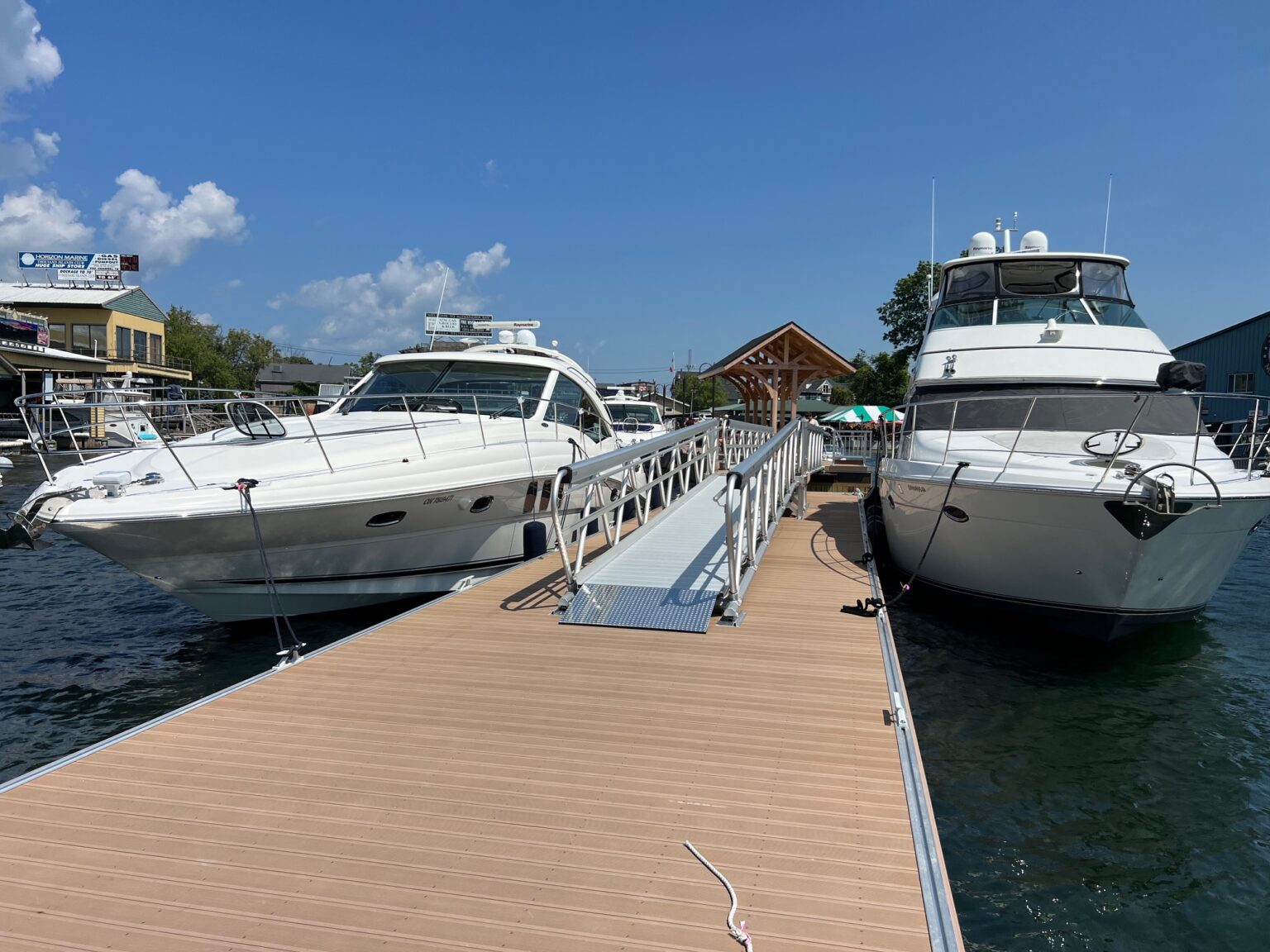
Yachts moored at aluminum floating docks, Alexandria Bay Municipal Dock, New York
Dock Systems

Our floating dock systems for lakes

Two of MAADI Group’s three interoperable floating dock systems are particularly well suited for lake applications. Both feature fully welded, marine-grade aluminum frames supported by unsinkable polyethylene floats. Their modular and interoperable designs allow both systems to be seamlessly integrated within the same marina, accommodating everything from small recreational boats to larger yachts.

Recreational motorboat moored at an aluminum floating dock
01

Lakeshore™ for protected lakes and recreational boats

Lakeshore™ is optimized for protected waters and recreational use, for boats from 20 to 40 ft (6.1 to 12.2 m). Main docks run 4 to 8 ft (1.2 to 2.4 m) wide, finger docks form the boat slips, and the standard freeboard is 10 to 20 in (254 to 508 mm). The full range sits on our aluminum floating docks page.

Pleasure yachts berthed at an aluminum floating dock
02

Great Lakes™ for large lakes and changing levels

Great Lakes™ is engineered for heavy freshwater or saltwater conditions and variable water levels. It berths pleasure yachts from 20 to 80 ft (6.1 to 24.4 m) on docks up to 11 ft (3.4 m) wide, with a standard freeboard of 14 to 24 in (356 to 610 mm).

Site Conditions

Lake conditions that shape a floating dock

01

Water levels that rise and fall

A floating dock rises and falls with the lake’s water level, maintaining a consistent deck height above the water surface, even during seasonal fluctuations or reservoir drawdowns. The anchoring system must be engineered to accommodate these vertical movements while maintaining the dock’s stability and position.

02

Ice and cold lake winters

Marine-grade aluminum retains its strength and ductility at low temperatures, making it well suited for floating dock structures in cold climates. However, whether a floating dock can safely remain in the water throughout winter depends on several factors, including ice thickness, ice movement, site exposure, water depth, and anchoring conditions. Our guide, Can Floating Docks Stay in Ice?, explains the key site conditions that must be evaluated before deciding whether a dock can remain installed year-round.

03

Wind and waves across open water

On lakes with long stretches of open water, wind can generate significant waves and challenging operating conditions. MAADI Group’s universal dock connectors accommodate relative movement between floating modules, helping reduce structural stresses while providing a stable and comfortable walking surface. Engineered for demanding environments, our Lakeshore™ floating dock system is designed to withstand severe storm conditions, including wind speeds of up to 74 mph (120 km/h).

Aluminum gangway leading to floating docks among the islands at Alexandria Bay, New York
Anchoring

Anchoring a floating dock on a lake

The selection of an appropriate floating dock anchoring system depends on water depth, lakebed conditions, and seasonal water-level fluctuations. MAADI Group offers four anchoring methods to accommodate different site conditions and ensure the stability and proper positioning of floating dock systems.

Pile passing through an internal pile guide in a Great Lakes aluminum floating dock
01

Push-arm anchoring

Ideal for shoreline installations where H-beam anchoring is not feasible due to the absence of a seawall or bulkhead. Strong currents and significant horizontal loads from moored vessels may present additional engineering challenges. Depending on current velocity, vessel loads, and site-specific conditions, supplemental tie cables may be required to ensure adequate lateral stability.

02

Pile anchoring

Ideal for shallow-water installations, typically up to 20 ft (6.1 m) deep. Not recommended for locations subject to thick ice or significant ice movement, as ice forces may damage or displace the piles. Additionally, ice adhering to the piles can generate significant upward forces as water levels rise, potentially causing pile uplift or extraction from the lakebed.

03

Deadman anchoring

Ideal for deep-water installations, typically up to 60 ft (18 m) deep, using concrete deadweight anchors, helical anchors, or plow anchors. Anchoring in greater depths is also feasible by combining lightweight, high-strength synthetic ropes with steel chains. This hybrid configuration reduces the overall weight of the mooring lines and the additional buoyancy required to support them, compared with an all-chain system. The anchoring system is engineered according to water depth, lakebed conditions, current velocity, wind and wave loads, and horizontal forces generated by moored vessels. Anchor lines must also accommodate seasonal water-level fluctuations while maintaining adequate restraint and stability of the floating dock.

04

H-beam anchoring

Ideal for floating dock installations alongside seawalls, bulkheads, or other suitable fixed structures, particularly where significant seasonal water-level fluctuations occur. The H-beam anchoring system allows the floating dock to move vertically with changing water levels while restricting horizontal displacement. The beams, sliding connections, and supporting structure must be engineered to withstand environmental loads, including wind, waves, currents, and forces generated by moored vessels. At locations exposed to frequent or significant boat wakes and wave action, MAADI Group incorporates its ShockGUARD™ system to absorb impacts, reduce noise and vibration, and minimize premature wear on the sliding components and anchoring connections.

Every anchoring system is engineered by MAADI Group’s licensed Professional Engineers to accommodate the full range of seasonal water-level fluctuations at your site while maintaining the floating dock’s stability and position.

Plan your lake dock with an engineer

Tell us about your project, including water depth, shoreline conditions, seasonal water-level fluctuations, and the types and sizes of boats you plan to accommodate. MAADI Group will develop a preliminary dock layout and provide a customized quotation tailored to your site and requirements.

Specifications

Lake dock specifications

3D rendering of the Great Lakes aluminum floating dock system
SpecificationLakeshore™Great Lakes™
Boat length20 to 40 ft (6.1 to 12.2 m)20 to 80 ft (6.1 to 24.4 m)
Dock width4 to 8 ft (1.2 to 2.4 m)4 to 11 ft (1.2 to 3.4 m)
Module lengthup to 42 ft (12.8 m)up to 42 ft (12.8 m)
Standard freeboard10 to 20 in (254 to 508 mm)14 to 24 in (356 to 610 mm)
Reserve buoyancy20 to 30 psf (0.96 to 1.44 kPa)30 to 50 psf (1.44 to 2.39 kPa)
Vertical loadup to 100 psf (4.8 kPa)up to 150 psf (7.2 kPa)
Impact resistance22-ton boat at 1.6 fps (0.5 m/s), 10° angle, absorbed over 3 ft (900 mm) of dock60-ton boat at 1.6 fps (0.5 m/s), 10° angle, absorbed over 3 ft (900 mm) of dock
Stabilitymaximum tilt of 10° with live load on one sidemaximum tilt of 10° with live load on one side

Our freeboard calculator helps match the deck height to kayaks, PWCs and yachts before the system is chosen.

Components

Decking, floats and fittings for lake docks

MAADI Group offers two premium decking options: composite decking, with an expected service life of at least 25 years, and Ipe hardwood, with an expected service life of at least 40 years. Both options can be installed without requiring periodic sealing or protective treatments, minimizing long-term maintenance. Ipe hardwood naturally develops a silver-gray patina over time unless treated to preserve its original color.

For a detailed comparison of barefoot comfort, surface temperature, slip resistance, and available finishes, explore our decking selection guide.

Our floating dock systems are supported by unsinkable rotomolded polyethylene floats, featuring an expanded polystyrene (EPS) foam core for reliable flotation and long-term durability.

An integrated aluminum accessory track allows cleats, bollards, ladders, and other dock accessories to be securely mounted and repositioned as docking requirements or layouts evolve.

The aluminum structure is backed by MAADI Group’s 12-year limited warranty, covering material failure, manufacturing defects, and corrosion, subject to the warranty’s terms and conditions.

Applications

Lake floating docks for homes, resorts and marinas

MAADI Group engineers and manufactures custom aluminum floating docks for a wide range of lakefront applications, from private waterfront properties and resorts to yacht clubs, commercial marinas, and municipal waterfront facilities.

Whether designing a single residential dock or a complete lake marina, we apply the same engineering principles, structural design standards, and commitment to long-term durability.

For private waterfront applications, explore our residential floating dock solutions. For larger developments requiring multiple slips, interconnected docks, and future expansion capabilities, discover our custom aluminum marina systems.

Delivery

Delivery and installation of your lake dock

  • MAADI Group ships its aluminum floating dock systems as preassembled sections on trailers or in shipping containers for on-site assembly, depending on project size, destination, and transportation requirements.
  • Installation can be performed by a qualified local marine contractor under MAADI Group’s technical supervision or by one of our certified installers. Upon completion, one of our licensed Professional Engineers can perform a final inspection to verify that the installation conforms to the approved engineering drawings and project specifications.
  • Safe and convenient shoreline access is provided through our custom-engineered marine aluminum gangways, designed to accommodate site-specific conditions and fluctuating water levels.
  • All structural designs and engineering calculations are prepared under the responsibility of a licensed Professional Engineer, with engineering documents signed and sealed in accordance with applicable professional requirements.
FAQ

FAQ: floating docks for lakes

What is the best floating dock for a lake?

The best floating dock for a lake depends on wind and wave exposure, seasonal water-level fluctuations, and the size and type of vessels it must accommodate.

For protected lakes and recreational boats up to 40 ft (12.2 m), MAADI Group’s Lakeshore™ aluminum floating dock system offers an excellent combination of stability, durability, and versatility.

For larger lakes with more demanding environmental conditions or yachts up to 80 ft (24.4 m), our Great Lakes™ system provides a more robust solution.

Both systems feature fully welded marine-grade aluminum frames supported by unsinkable rotomolded polyethylene floats and are engineered for site-specific conditions.

Can a floating dock stay in the lake over winter?

Yes, a properly engineered aluminum floating dock can remain in the lake year-round, depending on local ice conditions. Key factors include ice thickness, ice movement, water depth, wind and wave exposure, and seasonal water-level fluctuations.

Marine-grade aluminum retains excellent mechanical properties at low temperatures. However, anchoring systems must withstand ice-related forces, particularly where thick or moving ice can damage piles or generate uplift forces.

MAADI Group’s licensed Professional Engineers evaluate site-specific ice loads and environmental conditions to determine whether a floating dock can safely remain installed throughout winter.

Learn more about whether floating docks can stay in ice.

How is a floating dock anchored in a lake?

Floating docks are anchored using four primary methods, depending on water depth, shoreline conditions, seasonal water-level fluctuations, and environmental loads.

  • Push-arm anchoring: Ideal along shorelines without seawalls or bulkheads, particularly where water-level variations are limited.
  • Pile anchoring: Suitable for shallow water, typically up to 20 ft (6.1 m), where significant ice movement is not expected.
  • Bottom anchoring: Uses concrete deadweight, helical, or plow anchors in deeper water, typically up to 60 ft (18 m) or more with specialized mooring systems.
  • H-beam anchoring: Ideal alongside seawalls or bulkheads, allowing vertical movement while restricting horizontal displacement.

MAADI Group’s licensed Professional Engineers design each anchoring system to accommodate site-specific environmental conditions and maintain dock stability.

Is aluminum better than wood for a lake dock?

Yes. For long-term durability and minimal maintenance, aluminum floating docks offer significant advantages over traditional wood docks. Wood is susceptible to rot, warping, splitting, and deterioration, particularly in climates with repeated freeze-thaw cycles.

Marine-grade aluminum does not rot or warp and naturally forms a protective oxide layer that provides excellent corrosion resistance without requiring protective coatings. Its durability and low maintenance requirements make it an ideal choice for residential and commercial lake docks.

Discover the long-term benefits and lifecycle advantages in our Why Aluminum? guide.

How much does a floating dock for a lake cost?

The cost of a floating dock for a lake depends on its size, structural design, decking materials, anchoring system, and site-specific environmental conditions. Water depth, shoreline access, vessel requirements, and installation logistics can also influence the total project cost.

MAADI Group engineers and manufactures custom aluminum floating docks tailored to each project. Share your shoreline conditions, water depth, and boat sizes with our team to receive a preliminary dock layout and customized quotation.

Learn more about the factors affecting pricing in our Floating Dock Cost Guide.

Can a lake dock be expanded later?

Yes. MAADI Group’s modular aluminum floating dock systems are designed for future expansion and reconfiguration. Additional dock sections, walkways, and finger piers can be integrated as boating needs evolve or marina capacity increases.

All three MAADI floating dock systems are interoperable, allowing our engineers to combine different configurations, such as Lakeshore™ and Great Lakes™, to accommodate larger vessels or changing operational requirements.

Any expansion is evaluated by our licensed Professional Engineers to ensure structural compatibility, adequate flotation, and anchoring capacity under the revised loading conditions.

Talk to us about your lake

One team engineers, fabricates and supervises the installation of your dock.