



Is steel cheaper than aluminum? Per pound, on the day you buy it, usually yes. Over the life of a structure, the answer flips more often than most budgets assume. This article breaks down where steel's price advantage comes from, where it disappears, and what a published engineering study found when two comparable structures, one steel and one aluminum, were tracked over decades.
The Short Answer: Steel Is Cheaper Upfront, Aluminum Is Cheaper to Own
Raw steel typically costs less than aluminum per pound, which is why "steel is cheaper" has been the default assumption in construction and infrastructure for decades. But a structure is not bought by the pound, and it is not paid for only once.
Total cost of ownership (TCO) counts everything a structure costs across its life: initial material, fabrication, installation, maintenance, inspections, repairs, downtime and end-of-life disposal. On that ledger, steel's upfront saving is frequently spent, then exceeded, on coatings, repainting cycles and corrosion repairs. Aluminum costs more on day one and then, in many applications, almost nothing after.
Steel may cost less on day one. Aluminum delivers lower costs over the life of the structure.
Why Steel Looks Cheaper Than Aluminum on Paper
The price gap begins with primary metal production. Producing aluminum requires refining bauxite into alumina and then reducing the alumina to metallic aluminum through an electricity-intensive electrolytic process. This gives primary aluminum a significantly higher commodity price per pound than common carbon steel. On raw material price alone, steel has the clear advantage—but price per pound tells only part of the story when comparing finished structures.
Two factors immediately narrow that gap in real projects:
- Density and structural weight. Aluminum has roughly one-third the density of steel. While aluminum structures generally require larger sections or greater thickness to compensate for aluminum's lower modulus of elasticity, the finished structure can still weigh approximately 40% to 50% less than a comparable steel structure designed to the same standards. That means significantly fewer pounds of material are required, making a simple aluminum-versus-steel price-per-pound comparison misleading when evaluating the true cost of a finished structure.
- Everything the light weight touches. Lighter structures mean smaller foundations, cheaper transport, faster installation, and lifting equipment you may not need at all. Those savings land in the project budget before the structure carries its first load.
So even at the purchase stage, "Is steel cheaper than aluminum?" is not as simple as comparing price per pound. In fact, upfront cost is typically where steel has its greatest advantage. Beyond that, aluminum begins to gain ground through lower weight, corrosion resistance, reduced maintenance, and lower life-cycle costs.
What Steel's Price Tag Leaves Out
Steel rusts—and corrosion turns into cost.
The initial price of a steel structure does not tell the whole story. To perform outdoors, particularly in marine and waterfront environments, carbon steel typically requires galvanizing, protective coating systems, or both to protect it against corrosion.
Those protective systems do not last forever. Over the life of a pedestrian bridge, dock, gangway, or other waterfront structure, steel may require periodic inspections, surface preparation, coating repairs, repainting, corrosion treatment, and eventually more substantial rehabilitation.
And the cost extends beyond materials and labor. Maintenance on bridges and public infrastructure can also require closures, scaffolding, specialized access equipment, traffic or pedestrian control, and operational downtime.
Aluminum takes a fundamentally different approach. Its natural corrosion resistance can eliminate many of the recurring protective-coating and corrosion-maintenance requirements associated with carbon steel. That is why comparing steel and aluminum solely on their initial purchase price can overlook a significant part of the structure's true life-cycle cost.
For a more detailed engineering and cost comparison, explore our Steel vs. Aluminum Pedestrian Bridges study:
Steel vs. Aluminum Pedestrian Bridges – MAADI Group
Marine-grade aluminum forms its own protective oxide layer naturally. It needs no coatings, no galvanizing and no repainting, and it does not rust, even in saltwater environments. That is the structural reason why aluminum delivers a 30 to 50 year service life with little to no maintenance, and why the maintenance line of an aluminum structure's budget is close to a flat zero.
Compare Aluminum vs Steel Costs on Your Project
Send us your span, site and loads; our engineers will show you what the structure really costs over its life.
Get a QuoteReal-World Maintenance Costs: Steel vs. Aluminum
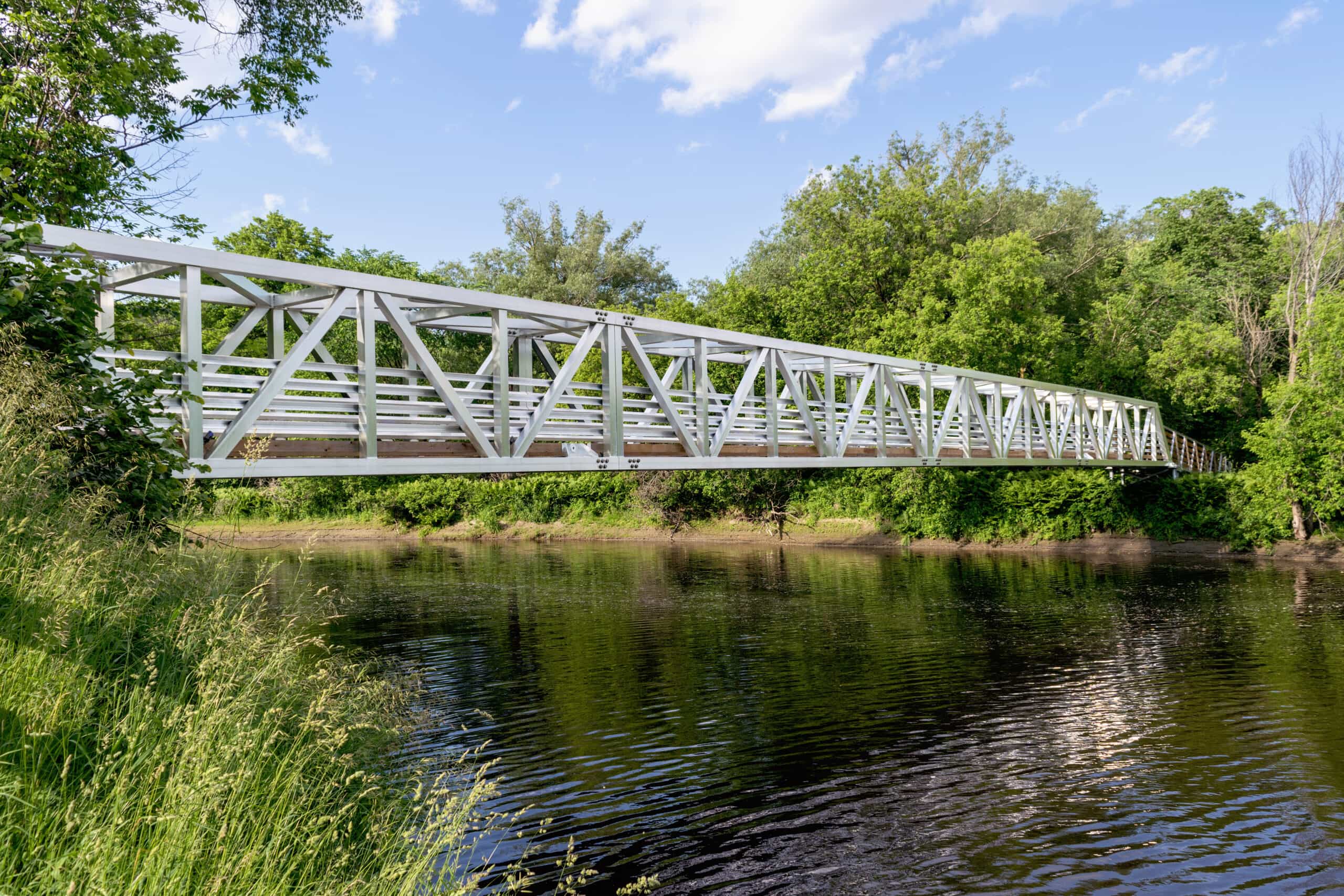
A comparative case study published in Canadian Consulting Engineer examined two structures designed for similar applications and exposed to comparable Canadian climatic and environmental conditions: one constructed of carbon steel and the other of aluminum.
The structures are not the same age or size, so comparing their total maintenance expenditures directly would be misleading. The steel structure was installed in 1988, while the aluminum structure was installed in 2002—14 years later. Their walking areas also differ substantially: approximately 2,997 sq. ft. for the steel structure versus 820 sq. ft. for the aluminum structure.
For this reason, the steel structure's documented maintenance history can also be expressed on a per-year and per-square-foot basis to provide a more meaningful comparison.
The Steel Structure: $814,000 in Maintenance and Repairs
By 2020, after 32 years of service, the 2,997-sq.-ft. steel structure had accumulated approximately $814,000 CAD in repair and maintenance expenditures.
That represents an historical average of approximately:
- $25,438 CAD per year
- $8.49 CAD per sq. ft. of walking area per year
These costs illustrate an important aspect of steel infrastructure that is not reflected in its initial material price: corrosion protection and maintenance continue long after the original structure has been purchased.
The Aluminum Structure: More Than 24 Years Without Corrosion-Related Structural Maintenance
The comparable MAADI aluminum bridge has approximately 820 sq. ft. of walking area. It was sold on June 17, 2002 for $101,760.14 CAD.
Adjusted using Canada's Consumer Price Index, that original purchase price is approximately $172,000 CAD in 2026 dollars. Statistics Canada's June 2026 all-items CPI was 169.0 on a 2002=100 basis.
More importantly, after more than 24 years of service in a waterfront environment, the mill-finish aluminum structure has required no corrosion-related structural repairs, protective coatings, or repainting.
What Would the Steel Maintenance History Mean for an 820-sq.-ft. Structure?
Applying the steel structure's documented average maintenance expenditure of approximately $8.49 CAD/sq. ft./year to the aluminum bridge's 820-sq.-ft. walking area produces an equivalent historical maintenance cost of approximately:
$6,960 CAD per year
Over 24 years, that would represent approximately:
$167,000 CAD in equivalent maintenance expenditure based on the steel structure's documented history.
That amount is particularly significant when compared with the aluminum bridge's original purchase price of $101,760.14 CAD in 2002, or approximately $172,000 CAD when expressed in 2026 dollars.
In other words, based on this specific steel structure's documented maintenance history and normalized for walking area, 24 years of equivalent maintenance expenditure would approach the entire inflation-adjusted original purchase price of the aluminum bridge.
The Purchase Price Is Only the Beginning
This case study does not imply that every steel structure will incur the same maintenance costs or that every aluminum structure will remain maintenance-free. Design, exposure, detailing, protective systems, usage and maintenance practices all influence long-term performance.
What the comparison does demonstrate is why evaluating steel versus aluminum infrastructure on initial price alone can be misleading.
For bridges and waterfront structures expected to remain in service for decades, the economic comparison should consider not only the original purchase price, but also corrosion protection, inspections, repainting, repairs, rehabilitation, access equipment, closures and operational downtime.
In this documented case, the aluminum structure's corrosion resistance has translated into more than two decades without corrosion-related structural maintenance—while the historical maintenance expenditure of the steel structure, normalized for size, would have approached the aluminum bridge's entire inflation-adjusted acquisition cost over the same 24-year period.
Steel vs. Aluminum: The Numbers at a Glance
| Metric | Steel Structure | Aluminum Structure |
|---|---|---|
| Year | 1988 | 2002 |
| Walking area | 2,997 sq. ft. | 820 sq. ft. |
| Documented service period | 32 years to 2020 | 24+ years to 2026 |
| Documented repair & maintenance | $814,000 CAD | No corrosion-related structural maintenance |
| Average historical maintenance | $25,438/year | — |
| Maintenance per walking area | $8.49/sq. ft./year | — |
| Equivalent maintenance at 820 sq. ft. | $6,960/year | — |
| 24-year equivalent | ≈ $167,000 CAD | — |
| Original aluminum bridge price | — | $101,760.14 CAD |
| Approx. price in 2026 dollars | — | ≈ $172,000 CAD |
You can read the full study on the Canadian Consulting Engineer website, or our detailed aluminum vs steel total cost of ownership analysis for the complete breakdown.
Total Cost of Ownership: Where the Money Actually Goes
Acquisition and Fabrication
Aluminum costs more per pound but weighs one third as much, and extrusion allows complex, structurally efficient profiles that reduce part counts and welding time. The upfront premium of an aluminum structure is real, but it is smaller than the commodity prices imply.
Transport and Installation
Lightweight aluminum components ship on standard trailers and install with smaller equipment and crews. Prefabricated aluminum structures, from bridge kits to modular dock systems, compress installation schedules that steel cannot match without heavy machinery.
Maintenance and Repairs
This is where steel loses. Recurring coating and repair cycles compound over decades, while marine-grade aluminum runs maintenance-free. In the published study, that difference alone was worth $8.49 CAD per sq. ft. of walking area per year on that steel structure.
End of Life
Aluminum is 100% recyclable and holds high scrap value; recycling recovers up to 95% of the energy used in original production. A retired aluminum structure is an asset, not a disposal cost.
Where Aluminum Wins, and Where Steel Still Makes Sense
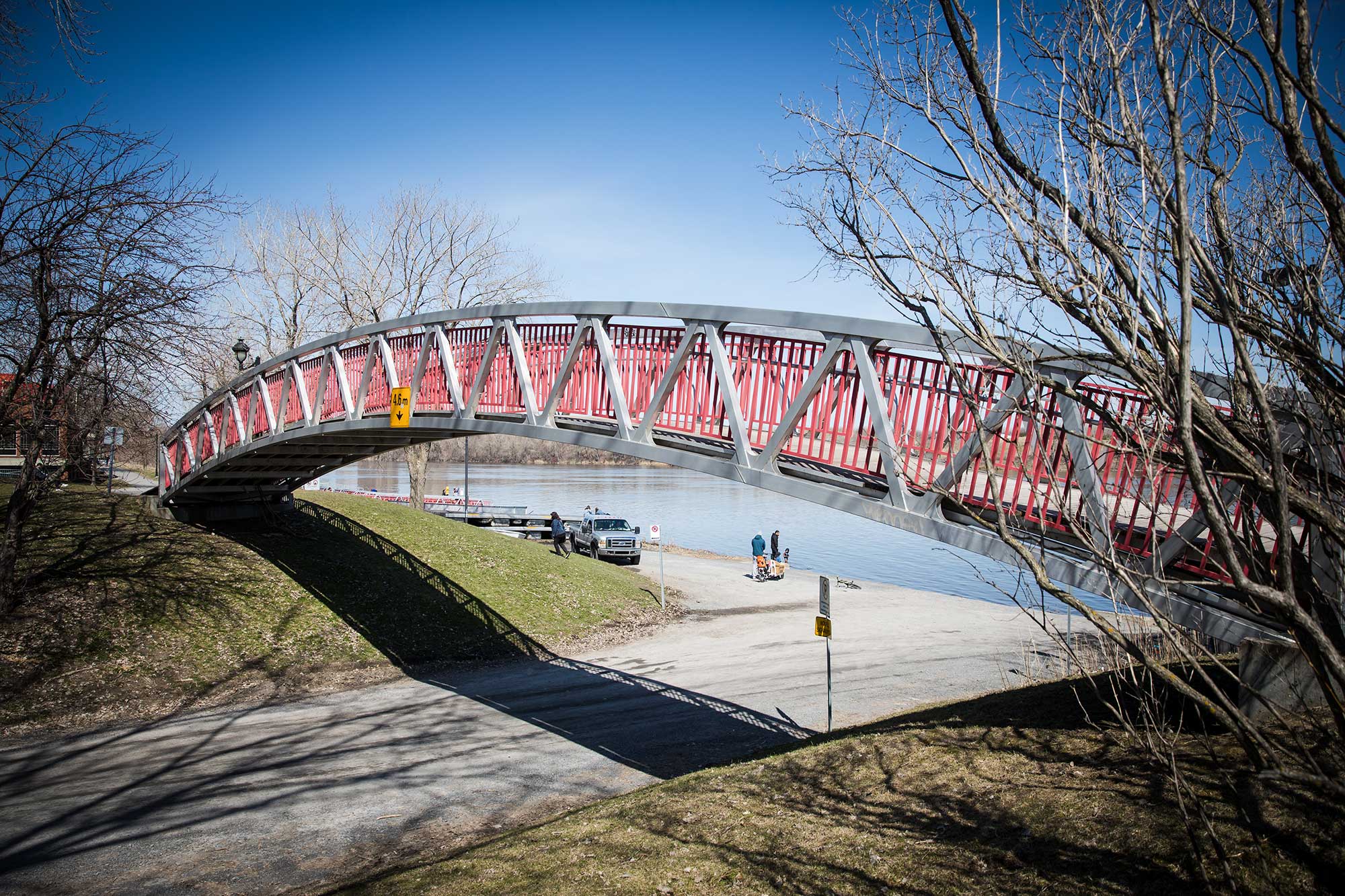
Aluminum's cost advantage is strongest wherever corrosion, access or weight drive the budget. Marine and coastal structures such as floating docks, marine aluminum gangways and full custom aluminum marina systems live in salt water, where steel's protection cycle is fastest and most expensive. Pedestrian bridges on parks and trails benefit for a different reason: they sit where repair crews are hardest to bring in, so a maintenance-free material eliminates the costliest logistics.
Steel keeps its place in applications dominated by very high loads and where the structure lives indoors or under an active maintenance program that is already budgeted. An honest cost comparison is application by application, which is exactly how an engineer should run it.
The right question is not which metal is cheaper, but which structure costs less over the decades you will own it.
Get the True Cost of Ownership for Your Structure
One quote, priced for the decades, from the engineers who published the numbers.
Request Your QuoteAluminum vs Steel Cost FAQs
Is steel cheaper than aluminum?
Per pound of raw material, steel is usually cheaper than aluminum. Per structure, over its service life, aluminum is frequently the lower-cost material once maintenance, coatings, repairs and downtime are counted. A published Canadian Consulting Engineer study found a 2,997 sq. ft. steel structure built in 1988 incurred $814,000 in repairs and maintenance in 32 years, while a comparable aluminum structure installed in 2002 required zero maintenance investment after 24 years of its installation.
Why does aluminum cost more per pound than steel?
Producing aluminum from bauxite ore takes significantly more energy than producing common carbon steel, which raises its commodity price. However, aluminum weighs roughly one third as much as steel, so a structure needs far fewer pounds of it. Comparing finished structures rather than raw pounds shrinks the gap considerably.
Is aluminum cheaper than steel in the long run?
In corrosive or hard-to-access environments, yes, and often by a wide margin. Marine-grade aluminum needs no coatings, repainting or rust treatment and delivers a 30 to 50 year service life with little to no maintenance. Steel's recurring protection and repair cycles compound over decades and typically overtake its upfront saving.
How much maintenance does a steel structure need compared to aluminum?
Outdoor steel needs galvanizing or protective coatings, scheduled repainting, rust treatment and repair as protection degrades, plus the inspections and downtime that come with each cycle. Marine-grade aluminum forms its own protective oxide layer and requires virtually no maintenance. The aluminum structure tracked in the published study had not required a single dollar of maintenance investment since its installation in 2002.
Which is more cost-effective for marine structures, aluminum or steel?
Aluminum. Salt water accelerates steel corrosion, which makes its protection cycle faster, more frequent and more expensive precisely where access for repairs is hardest. Marine-grade aluminum resists saltwater corrosion naturally, which is why docks, gangways and marina structures engineered in aluminum carry the lowest total cost of ownership on the water.


