



MAADI Group at the Forefront of Aluminum Pedestrian Bridge Innovation in Canada
In the Spring 2018 edition of Civil magazine, Canadian engineers turned their focus toward a material that’s reshaping pedestrian infrastructure: aluminum. Central to this shift is MAADI Group, a pioneering Canadian firm whose modular bridge systems are helping redefine industry standards. Two companion articles highlighted this evolution:
-
Aluminum in Bridge Design and Construction
-
Aluminum Pedestrian Bridges: Recent Developments and Studies
Together, these articles spotlight key trends in aluminum bridge engineering and showcase MAADI Group’s leadership in delivering innovative, sustainable bridge solutions across Canada.
Why MAADI Group Champions Aluminum in Bridge Engineering
MAADI Group has long advocated for aluminum as a smart alternative to steel and concrete, especially in pedestrian and cyclist bridge applications. Their approach centers on aluminum’s exceptional corrosion resistance, light weight, and long service life — characteristics that are particularly valuable in harsh Canadian climates and remote installations. The Spring 2018 features reinforced what MAADI Group has been demonstrating in the field for years: aluminum bridges offer unmatched long-term value.
Corrosion Resistance & Minimal Maintenance
-
Naturally resists corrosion through a self-forming oxide layer, eliminating the need for paint or protective coatings.
-
Reduces long-term maintenance requirements, extending service life over decades.
-
Offers significant cost savings for municipalities and cities operating with tight infrastructure budgets.
Lightweight, Strong & Easy to Install
-
Weighs roughly one-third as much as steel, enabling efficient transport and handling.
-
Modular design allows quick on-site assembly, often with small crews and minimal equipment.
-
Cuts construction time and costs, particularly in remote or restricted-access locations.
MAADI Group’s MakeABridge® System: A Modular Milestone
Among the most important innovations highlighted in Civil is MAADI Group’s patented MakeABridge® system. This modular, weld-free design uses precision-engineered bolted components, making it ideal for urban infrastructure, remote trail crossings, and even military field deployments. The system’s adaptability and rapid deployment capabilities were noted as key trends in aluminum bridge construction.
While Canada’s national bridge code — the CHBDC — still offers limited aluminum-specific guidance, MAADI Group fills the gap with in-house engineering expertise, ensuring full code compliance through advanced modeling and quality assurance.
Notable Canadian Aluminum Bridge Projects
-
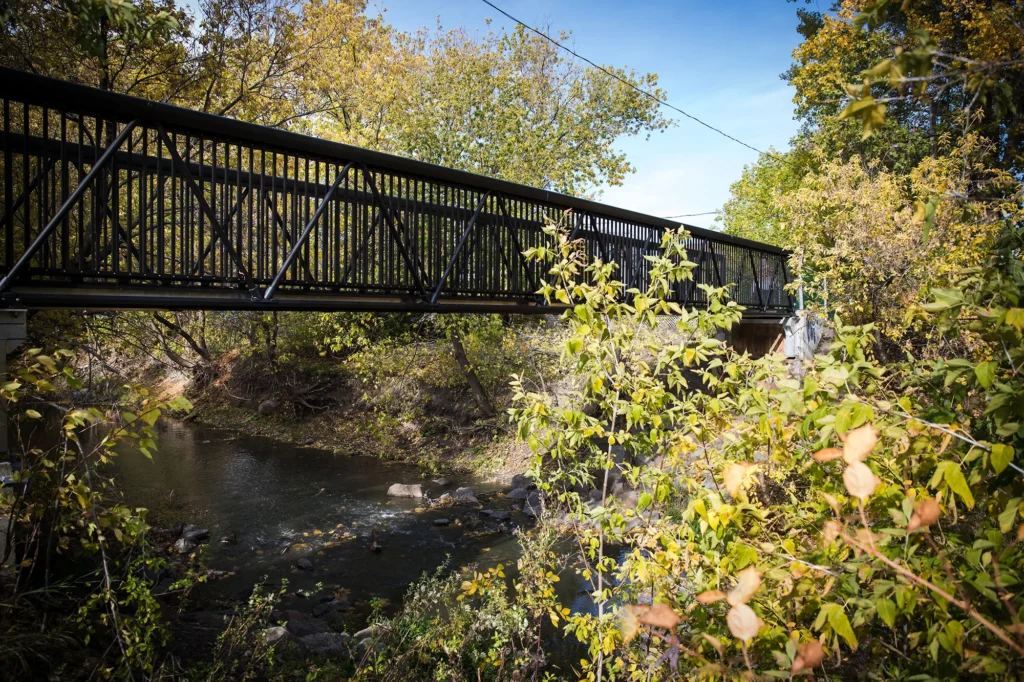
Brossard, Quebec (2005) – Modular aluminum pedestrian bridge designed and installed by MAADI Group; over a decade later, it shows no major wear or corrosion, proving aluminum’s long-term durability in Canadian climates.
-
Quebec & British Columbia – Aluminum bridges installed in parks, trails, and environmentally sensitive zones, supporting sustainability objectives.
-
Sustainable Material Choice – Aluminum is 100% recyclable, has a low carbon footprint, and can be produced using hydroelectric power — a clean, renewable energy source widely available in Canada.
Performance & Cost: What the Data Shows
-
Life-Cycle Savings – Deloitte Canada study found aluminum pedestrian bridges up to 25% more cost-effective over 50 years compared to steel, despite a slightly higher initial investment.
-
Lower Maintenance Needs – Reduced painting, coating, and repair requirements translate into major long-term savings for municipalities.
-
High Performance at Lower Lifetime Cost – Combines durability, sustainability, and economic efficiency, reinforcing MAADI Group’s value proposition.
Engineering Challenges and Design Considerations
Designing with aluminum comes with unique considerations — a topic that both Civil articles addressed. For instance, aluminum’s modulus of elasticity is lower than steel’s, meaning it’s more flexible under load. Its thermal expansion is also greater. However, MAADI Group’s engineering team has extensive experience with these variables, and their bridge systems are designed to accommodate movement, loading, and environmental conditions with precision.
Canada Leading the Way in Aluminum Bridge Deployment
Through its innovative work, MAADI Group is positioning Canada as a global leader in aluminum bridge construction. The Spring 2018 Civil magazine coverage underscored this momentum, citing growing adoption in urban centers like Montreal, Ottawa, and Vancouver, where aluminum pedestrian bridges are being used to connect transit stations, parks, stadiums, and waterfront developments.
With their sleek profiles and natural corrosion resistance, these bridges meet both aesthetic and functional demands — a hallmark of MAADI Group’s approach.
Looking Ahead: Aluminum Bridges as the New Standard
The message from Civil magazine is clear: aluminum pedestrian bridges are no longer a fringe concept — they’re a mainstream, future-proof solution. As more municipalities face aging infrastructure, constrained budgets, and rising environmental expectations, companies like MAADI Group offer a clear path forward.
With a proven track record, homegrown manufacturing, and an unwavering commitment to innovation, MAADI is helping redefine what Canadian infrastructure can be — durable, sustainable, and ready for the next 50 years.


