



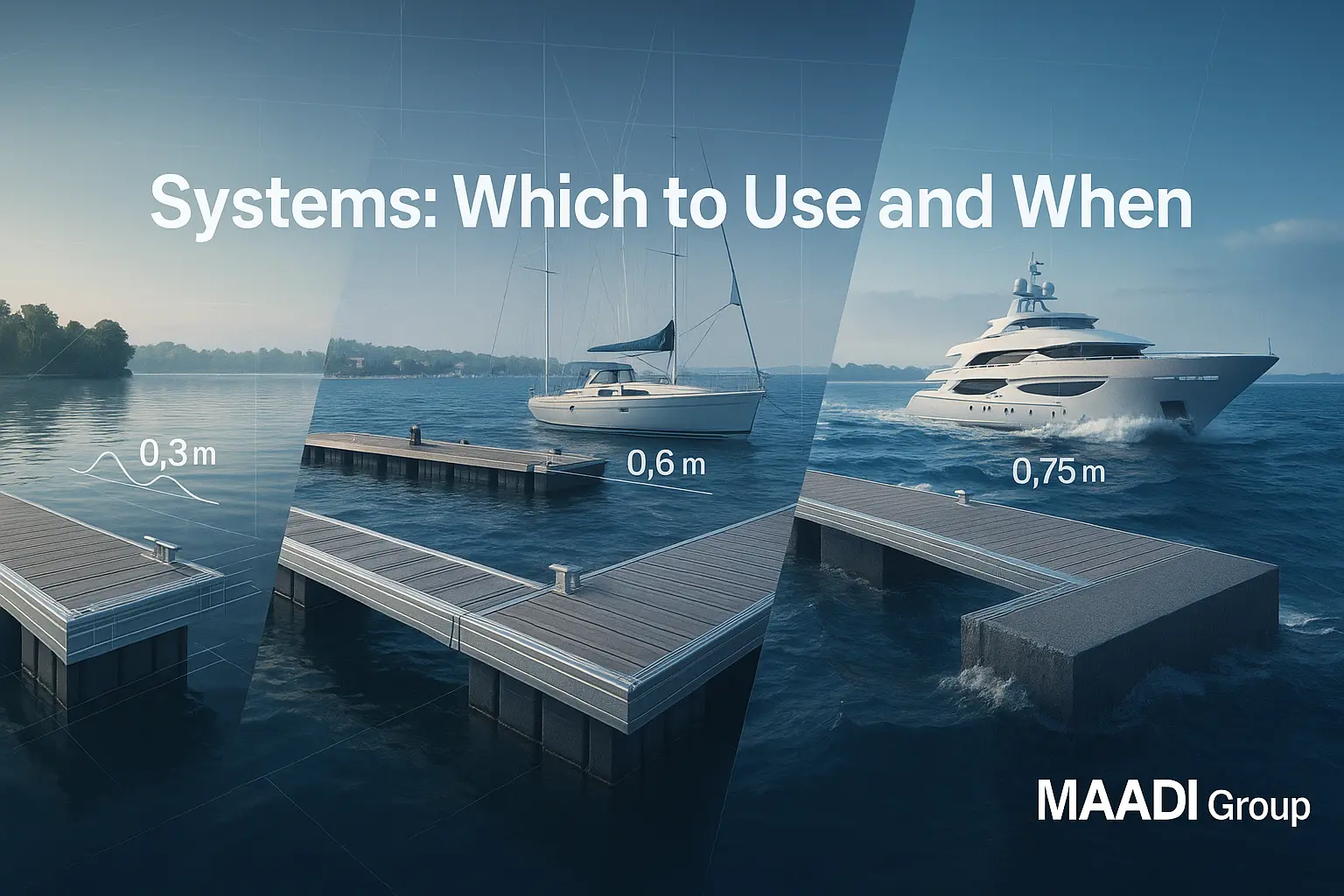
Choosing the right floating dock system depends on vessel size, sea conditions, and impact forces at your site. At MAADI Group, we specialize in engineered aluminum floating dock systems designed to perform under different marine environments. Whether you’re mooring small leisure boats or hosting superyachts, selecting the correct dock technology ensures safety, longevity, and efficiency.
Why Dock System Selection Matters
Not all marinas and waterfronts face the same issues. Serene inland lakes with smaller vessels necessitate a very different approach compared to seaside superyacht ports exposed to greater wave power. A properly planned floating dock system needs to consider:
- Wave height and site exposure
- Boat displacement and impact forces
- Structural durability and load distribution
- Flexibility for accessories and layout changes
For calm berthing, many marina guidelines target an interior Hs ≈ 0.3 m (~1 ft) to reduce mooring loads and improve comfort. See California Division of Boating & Waterways – Marina Design Manual for typical tranquility criteria used in planning.
MAADI Group Floating Dock Systems
Below is a comparison of our Lake Shore™, Great Lakes™, and Tri Ocean™ systems, highlighting vessel capacity, environmental performance, and structural features.
| System | Vessel Size | Significant wave height (H1/3) | Displacement / GT | T-Slot Track Design | Typical Application |
| Lake Shore™ | Up to 40 ft (12 m) | 12 in (0.3 m) | Up to 27,500 lb | Standard T-slot track on top + on vertical wall (exposed edge) | Inland lakes, calm rivers, private docks |
| Great Lakes™ | Up to 80 ft (24 m) | 24 in (0.6 m) | Up to 148,000 lb | Heavy-duty T-slot track on top + on vertical wall (exposed edge) | Larger marinas, coastal installations |
| Tri Ocean™ | Up to 200 ft (60 m) | 30 in (0.75 m) | 500 GT to 2,000+ GT | Two heavy-duty T-slot tracks on top + one heavy-duty on vertical wall | Superyacht marinas, oceanfront resorts |
Engineering Flexibility – Custom PE Services
Every site is unique. MAADI Group’s in-house Professional Engineering (P.E.) team adapts each system to your wave energy, tides, berthing geometry, and traffic patterns. We model local loads and specify the optimal configuration so your dock meets structural and safety requirements while minimizing total cost of ownership.
Engineered Docks – Backed by Structural Calculations
At MAADI Group, every floating dock system we design is backed by professional engineering and structural calculations. Using the Aluminum Design Standards, our team verifies local and global buckling, fatigue, welded joint resistance, and member capacity to ensure long-term safety and performance.


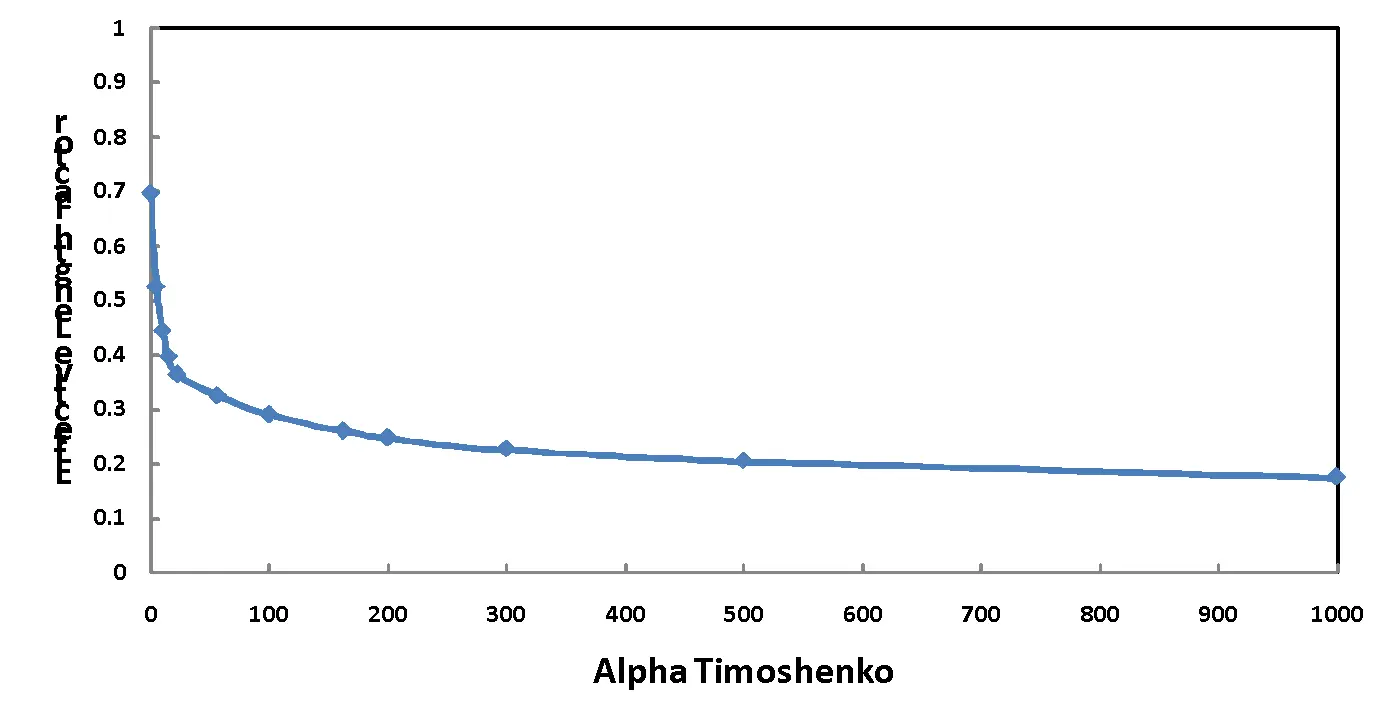
This is where we stand apart. Many competitors build docks without licensed engineers or code-based structural analysis. The result? Products that may look similar at first glance, but lack the proven resistance to environmental forces, boat impact, and fatigue over time.
By contrast, MAADI Group delivers engineered aluminum docks designed with the same rigor as bridges and offshore structures. Our clients benefit from:
- Verified load capacity against wave, wind, and boat forces
- Certified safety margins in compression, tension, and bending
- Durability ensured through proper weld and connection design
When you choose MAADI Group, you’re not just buying a dock—you’re investing in a precision-engineered structure built to last.
Understanding Boat Gross Tonnage (GT)
Dock system selection often relates to vessel gross tonnage (GT), a measurement of internal volume, not weight. The U.S. Coast Guard treats gross tonnage (GT) as a volume-based measure (not weight); for small craft, simplified estimates are provided in the USCG Marine Safety Center Tonnage Guide and 46 CFR Part 69. The U.S. Coast Guard simplified formulas provide a useful way to estimate GT for smaller boats:
- Simple sailing hull: GT = (0.5 × L × B × D) ÷ 100
- Sailing boat with keel: GT = (0.375 × L × B × D) ÷ 100
- Power boats: GT = (0.67 × L × B × D) ÷ 100
(Where L = length, B = breadth, D = depth in feet)
Engineered for Real-World Wave Conditions
Every marina or waterfront faces different environmental challenges. That’s why our aluminum floating dock systems are designed and engineered based on Significant Wave Height (H1/3) – the industry-standard measure of average sea state.
- Lake Shore™ – Residential Docks
Built for protected waters such as lakes and rivers, this system withstands wave heights up to 12 in (0.3 m H1/3) while supporting small boats up to 40 ft. - Great Lakes™ – Marina Applications
Designed for coastal and larger marina environments, it handles waves up to 24 in (0.6 m H1/3) and vessels up to 80 ft, offering proven durability under heavier loads. - Tri Ocean™ – Superyacht Infrastructure
Engineered for exposed sites and luxury developments, this system withstands 30 in (0.75 m H1/3) conditions and supports vessels from 200 ft to over 2,000 GT.
Which System Should You Use?
Because wave energy is dynamic, an H1/3 of 0.75 m means individual waves may reach twice that height. That’s why Maadi Group’s in-house Professional Engineering team custom-calibrates every dock system to local conditions, ensuring long-term safety, stability, and performance.
- If you are managing a private lakefront property or calm water marina, the Lake Shore™ system offers a cost-effective and durable solution.
• For coastal marinas and mixed fleets, the Great Lakes™ system balances strength with versatility.
• For luxury resorts and superyacht harbors, the Tri Ocean™ system delivers unmatched structural capacity and resilience.
At MAADI Group, we combine world-class aluminum fabrication with custom engineering to ensure that every dock meets its site’s demands. Explore our full range of floating dock systems here.


