


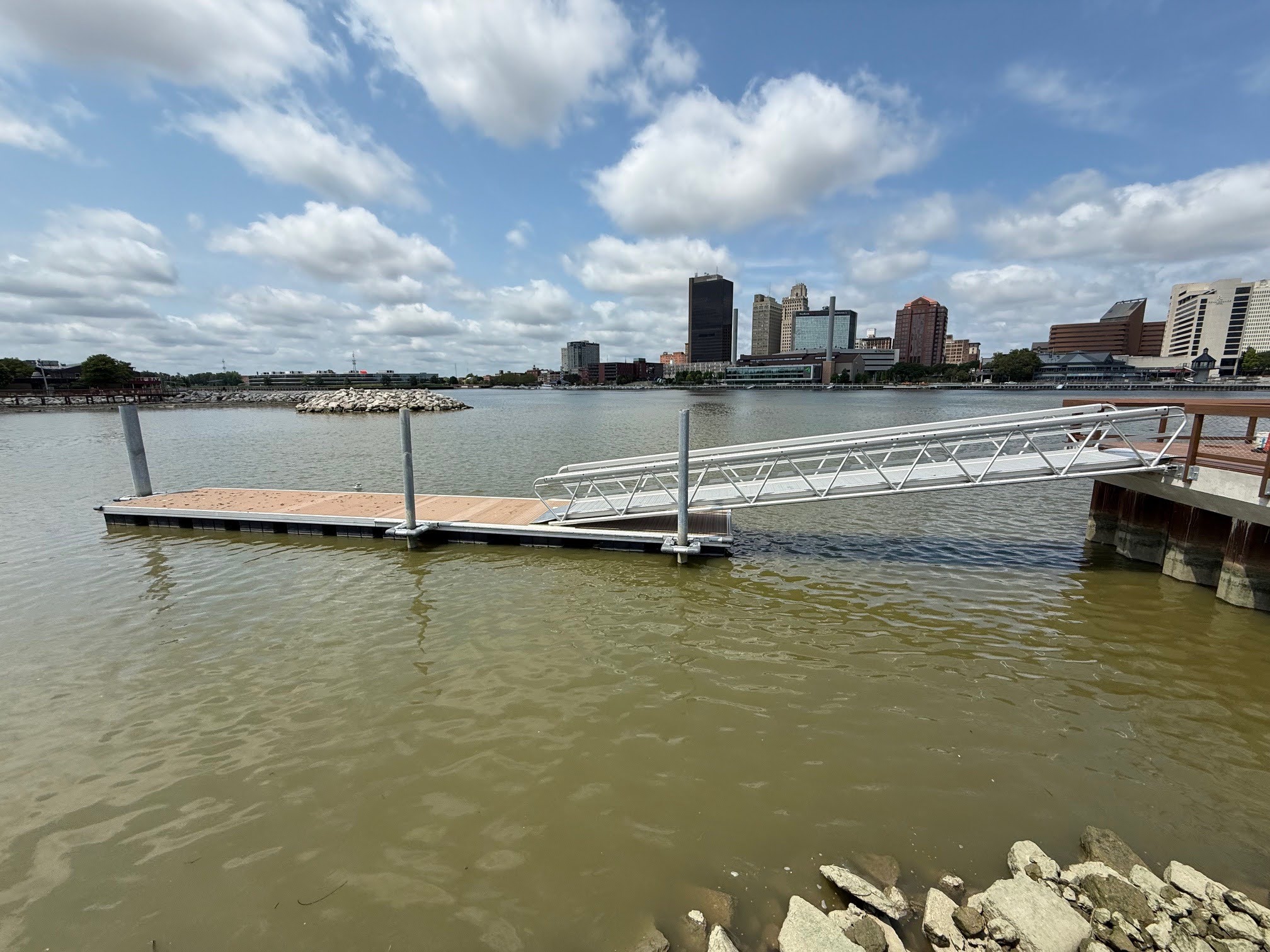
A gangway is an inclined access structure designed to provide a safe transition between two structures that can move relative to one another—vertically and, in some applications, rotationally—most commonly between a fixed pier or shoreline structure and a floating dock, or between a quay and a vessel.
A gangway is an access structure, not simply a dock accessory. Unlike a conventional fixed walkway, a marine gangway must accommodate changes in relative elevation resulting from tides, seasonal water-level fluctuations, reservoir drawdown, vessel movement and, depending on the site, storm surge and waves. In a typical floating-dock installation, one end is hinged while the opposite end is allowed to slide or roll as the dock rises and falls.
That movement makes gangway design more complex than simply sizing a pedestrian walkway. Length, slope, operating range, design loads, structural deflection, connection forces, accessibility, transition geometry, corrosion resistance and the reactions imposed on the supporting floating structure all influence the final design.
This guide examines commercial marine gangways from an engineering perspective: how their geometry is established, which structural loads govern their design, how accessibility affects length and slope, how materials are selected, and which structural and detailing decisions influence long-term performance.
How a Gangway Works
A gangway must accommodate relative movement between the two structures it connects while maintaining a safe and continuous access path. In a typical shore-to-floating-dock installation, the shore-side end is hinged to the fixed structure, allowing the gangway to rotate as the water level changes. The floating end is free to travel longitudinally, typically through rollers, a sliding arrangement or, in some configurations, a flexible connection system, allowing the gangway to flatten, steepen and change its horizontal reach without restraining the movement of the dock.
This articulation is what distinguishes a marine gangway from a conventional fixed walkway. As the floating dock rises or falls, the gangway changes both angle and horizontal position. If that required movement is unintentionally restrained, significant forces can develop in the gangway, its connections and the supporting floating structure.
Slope, Tide and Water-Level Range
Gangway geometry is governed primarily by the difference in elevation between its supporting structures and the horizontal distance available to accommodate that difference. For a floating-dock installation, the critical geometry must be evaluated throughout the full operating water-level range—not only at the normal water level.
Low water commonly produces the steepest downward gangway angle from shore to dock, while high water can create the opposite condition and may introduce different transition or clearance constraints. Both extremes therefore need to be checked.
A marina with a 2 ft (0.6 m) water-level range and one with a 12 ft (3.7 m) range may use similar floating docks but require very different gangway geometries. For a given difference in elevation, increasing the gangway's horizontal run reduces its slope. Where space is limited, landing elevations, intermediate platforms or alternative access arrangements may also influence the final design.
The required gangway length is therefore established from the site's design water levels, landing elevations, floating-dock freeboard, available horizontal run and applicable accessibility requirements.
The Connection at Each End
The connections are fundamental to gangway performance because they must transfer structural loads without preventing the movement the gangway is intended to accommodate.
At the fixed end of a typical shore-to-float gangway, a hinged or pinned connection transfers loads to the supporting structure while allowing the gangway to rotate as its angle changes.
At the floating end, the gangway must generally accommodate both rotation and longitudinal travel. Depending on the gangway length, weight, operating range, loading and dock configuration, this can be achieved through several arrangements, including a roller-and-plate detail, a flexible connection system, or a roller-and-rail assembly incorporating engineered wear components such as UHMW polyethylene wheels or pads. Each arrangement accommodates movement and transfers structural reactions differently, so the connection system must be selected as part of the overall gangway and floating-dock design.
Transition plates bridge the changing interface between the gangway and the adjoining walking surface and may be required at one or both ends depending on the configuration. Their geometry, surface treatment and movement range should be coordinated with the gangway throughout its full operating range to minimize abrupt changes in level and maintain a safe walking surface.
For commercial installations, these connections should not be treated as secondary hardware. They are part of the gangway's structural load path and movement system and must be designed for the reactions, travel and repeated articulation expected over the service life of the structure.
Types of Gangway on a Commercial Waterfront
Commercial waterfronts use different types of gangways depending on what they connect, how the water level changes and how people or equipment need to move across them. The most common distinction is between shore-to-float gangways, which provide access to floating docks, and vessel-access gangways, which provide a safe transition between shore and a moving vessel.
Marine gangways to floating docks
The most common configuration on a marina or resort waterfront. These marine aluminum gangways connect the shore structure to aluminum floating docks and carry pedestrian traffic, service carts and dock equipment at a stated load capacity across a range that never stops moving.
Shore gangways for vessel access
When the moving element is a vessel rather than a floating dock, the access geometry can become considerably more demanding. Aluminum shore gangways provide access to cargo ships, barges, bulk carriers, tankers and passenger vessels while accommodating changes in vessel draft, tide and loading conditions.
Depending on the application, gangways can be configured for inclines up to 30°, while stepped gangways can accommodate operating angles between 30° and 55°.
Internationally recognized standards for this type of equipment include ISO 7061:2024, Ships and marine technology — Aluminium shore gangways for seagoing vessels, and BS MA 78:1978, Specification for aluminium shore gangways. These standards establish requirements for the design, construction and testing of aluminum shore gangways.
Because commercial vessels operate between ports around the world, designing and manufacturing shore gangways to recognized marine standards provides a consistent technical basis for safe vessel access across international operations. Project-specific requirements may also be imposed by the vessel owner, classification society, port authority or other applicable regulatory body.
Ferry and transit access
Continuous passenger flow and vessel impact change the load case entirely. Gangways at aluminum ferry landings are engineered for peak crowd loading, rapid turnaround and the accessibility requirements that come with public transit.
Gangway kits
For remote sites or overseas projects requiring efficient shipment in crates or containers, or where local assembly is preferred, aluminum gangway kits provide a practical alternative to fully assembled gangways. The components are shipped as a weld-free, bolt-together system that can be assembled on site without specialized welding equipment.
Architectural options can include anodized finishes, baked-on paint finishes and integrated LED lighting systems, allowing the gangway to meet both functional and aesthetic project requirements.
The same structural design principles apply, but the system is engineered specifically for efficient shipping and field assembly—making gangway kits particularly well suited to remote waterfronts, international projects and locations where transporting a fully assembled structure would be difficult or costly.
ADA Compliance Is Mostly a Length Question
For facilities in the United States, gangway accessibility is addressed by the 2010 ADA Standards for Accessible Design, with specific requirements for recreational boating facilities. Ramps generally must maintain a running slope no steeper than 1:12 (8.33%) under Section 405.2. Recreational boating facilities, however, are subject to specific provisions under Section 1003.2.1 that recognize the practical challenges of providing an accessible route between fixed shore infrastructure and floating docks.
Two exceptions are particularly important. Where the total length of a gangway or series of gangways is at least 80 ft (24.4 m), the gangway is not required to comply with the maximum slope specified in Section 405.2. For facilities with fewer than 25 boat slips, the same exception applies where the total gangway length is at least 30 ft (9.1 m).
In practical terms, accessibility on a waterfront is often a question of available length. Water-level variation determines the vertical rise, while gangway length determines how that rise translates into operating slope. A design that works structurally may therefore still create an accessibility challenge if the site does not provide enough horizontal distance for an appropriately sized gangway.
For this reason, accessibility should be addressed early in waterfront planning rather than treated as a handrail or detailing issue at the end of the project. MAADI engineers gangway systems with operating slope, available length, handrails, edge protection and applicable accessibility requirements considered during the design stage, before they become issues during permitting or inspection.
What a Gangway Is Made Of
Marine-grade aluminum is the material of choice for engineered gangways, for structural and durability reasons before aesthetics. Properly selected marine aluminum alloys provide excellent corrosion resistance in seawater and have a proven history of more than 50 years in marine applications. MAADI designs its aluminum gangways for an expected 30- to 50-year service life with minimal maintenance, depending on exposure conditions and application. Aluminum's inherent durability and corrosion resistance contribute to its long service life, while its naturally forming protective oxide layer provides corrosion protection without relying on protective paint coatings.
Aluminum also weighs approximately one-third as much as steel, an advantage that matters twice on a waterfront: it reduces the dead load carried by the floating dock and makes transportation, installation and handling easier, often requiring less heavy equipment. Our why aluminum page provides a detailed comparison of aluminum with other structural materials.
Decking is specified independently from the structural frame according to durability, appearance, slip resistance, maintenance and project requirements. MAADI offers Ipe hardwood with a minimum 40-year expected service life, composite decking with a minimum 25-year expected service life, and ribbed aluminum decking designed to provide a service life comparable to the aluminum structure itself.
Ipe is particularly well suited to demanding exterior environments because of its exceptional natural resistance to decay and insects, while composite decking provides a low-maintenance alternative. Ribbed aluminum provides the most integrated solution, combining low maintenance, corrosion resistance and long-term durability.
The Details That Decide Service Life
A gangway's long-term performance depends as much on its detailing as on its primary structural members. Connections and weldments, walking surfaces, guardrails and moving components are exposed to repeated use, weather and constant movement, making their specification critical to both safety and service life.
- Guardrails. 42 in. (1,067 mm) high guardrails with 2 in. (50 mm) midrails at mid-height, designed to meet applicable U.S. and Canadian requirements.
- Handrails. 2 in. (50 mm) minimum hand clearance, with double handrails where traffic conditions or accessibility requirements call for them.
- Anti-slip surfaces. Walking surfaces selected for the most demanding wet, icy or cold conditions expected at the site—not simply average conditions.
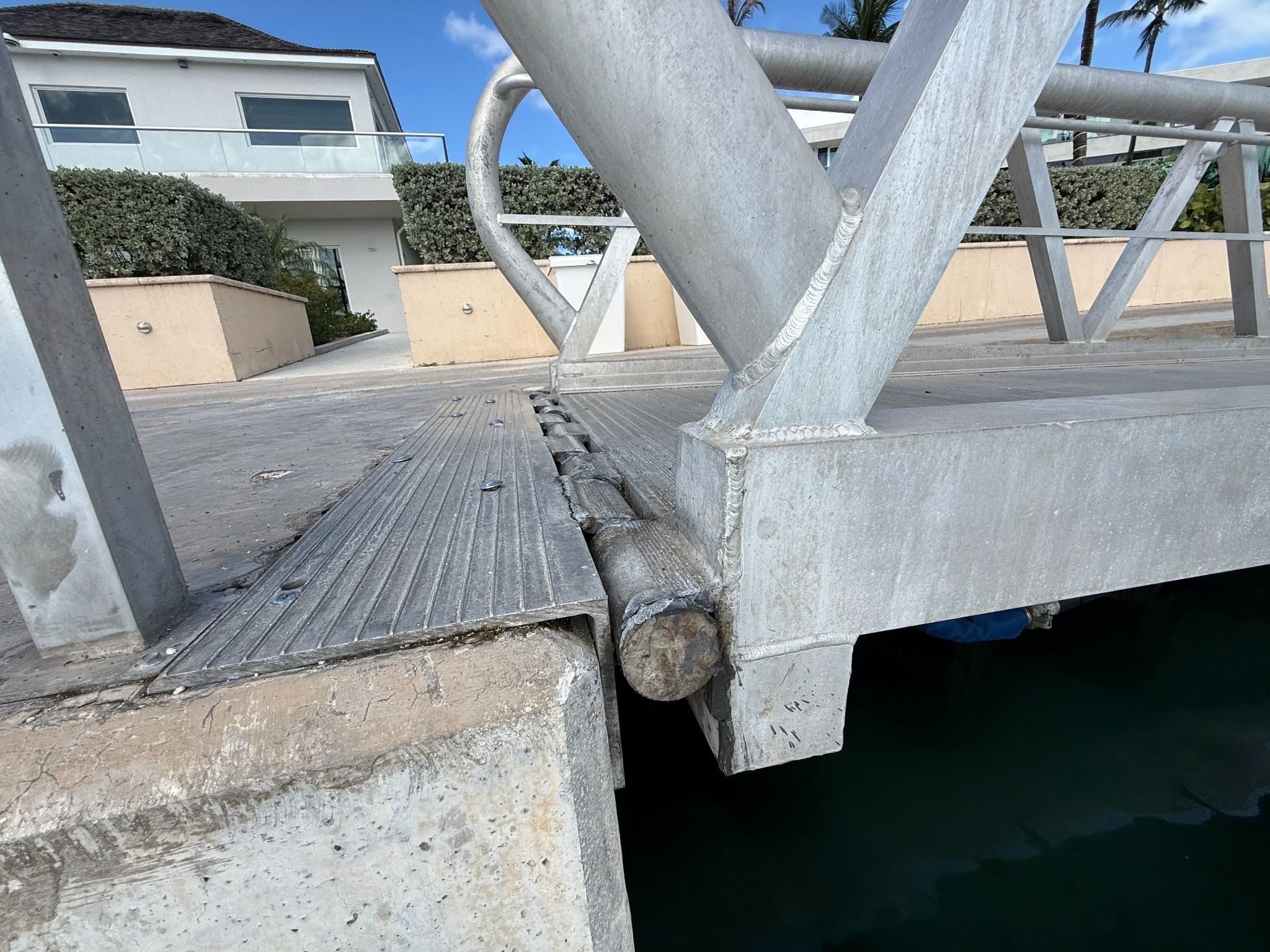
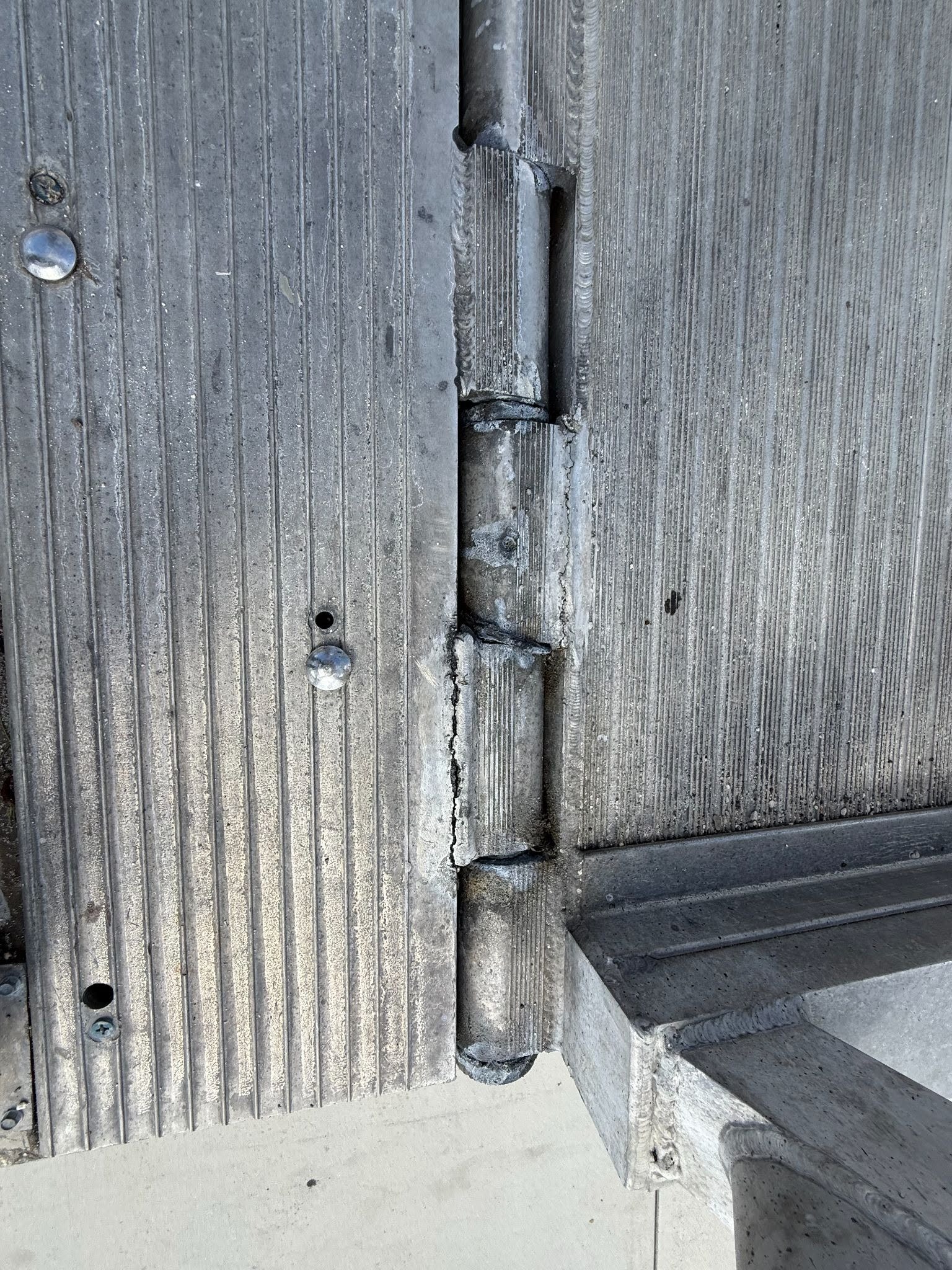
- Moving connections. In floating-dock applications, the gangway connections must accommodate the movement of the floating system without introducing unnecessary restraint into the structure. Roller-and-rail assemblies at the lower end allow the gangway to travel as the dock moves, while engineered flexible connections at the shore end accommodate the required rotation. Rigid metal-on-metal hinge connections that unnecessarily restrain movement should be avoided. Floating docks inherently experience horizontal movement within their pile-guide systems; restraining this movement can introduce additional stresses into the gangway, its connections and weldments, increasing the potential for fatigue and cracking over repeated wave cycles. Properly engineered connections that allow the required degrees of freedom are therefore a fundamental part of good gangway design.
- Warranty. MAADI gangways are backed by a 15-year limited warranty covering material failure, manufacturing defects and corrosion, subject to the terms and conditions of the warranty.
A gangway is one of the few components of a marina that virtually every user depends on—day after day, in changing weather and water conditions.
Talk to the Engineers Who Design the Structure
Every MAADI gangway is engineered, stamped and fabricated in-house, by Professional Engineers, Naval Architects and IWE-credentialed welding engineers.
Request a QuoteWhat Drives the Cost of a Gangway
Gangway pricing is driven by site conditions and engineering requirements rather than a standard catalogue price. Length and width largely determine the amount of structural material required, while gangway length itself is often governed by the water-level range, operating slope and accessibility requirements of the site.
Other major cost factors include design live load, decking selection, handrail and guardrail configuration, connection systems, shore-side abutment requirements, architectural finishes, lighting and site logistics.
Engineering should be part of the gangway—not an optional extra. A commercial gangway manufacturer should provide fabrication drawings sealed by a registered Professional Engineer (P.E.), supported by structural calculations addressing strength, serviceability and fatigue of critical connections and welded details.
This is particularly important for floating-dock gangways, where waves and dock movement can produce millions of load cycles over the structure's service life. A connection may satisfy a static load check yet still perform poorly under repeated cyclic loading. Proper fatigue design is therefore an essential part of a durable gangway system.
Because these variables differ substantially from one waterfront to another, engineered gangways are typically designed and quoted on a project-specific basis. Our guide to floating dock cost explains many of the same engineering and site factors for the floating dock system that a gangway serves.
Frequently Asked Questions About Gangways
What is a gangway on a dock?
On a dock, a gangway is an inclined, articulated walkway connecting a fixed shore structure—such as an abutment, seawall or pier—to a floating dock. Its connections allow the gangway to rotate and travel as the dock rises and falls with tides, waves or seasonal water-level changes.
What is the difference between a gangway and a ramp?
A ramp is a sloped walking surface, typically installed at a fixed slope. A gangway is designed to accommodate movement between structures at changing elevations, so its operating slope changes as the floating dock or vessel rises and falls. In floating-dock applications, engineered connections allow the necessary rotation and longitudinal movement without unnecessarily restraining the structure.
How long does a gangway have to be to meet ADA requirements?
Under Section 1003.2.1 of the 2010 ADA Standards for Accessible Design, a gangway—or series of gangways—with a total length of at least 80 ft (24.4 m) on an accessible route is not required to comply with the 1:12 maximum running slope specified in Section 405.2. At recreational boating facilities with fewer than 25 boat slips, the same exception applies when the total gangway length is at least 30 ft (9.1 m).
These exceptions apply specifically to gangway slope; other applicable accessibility requirements still apply. The appropriate gangway length for a particular site depends on the water-level range, landing elevations and applicable accessibility requirements.
What is the best material for a marine gangway?
Marine-grade aluminum is the material of choice for engineered marine gangways because of its high strength-to-weight ratio, corrosion resistance and low maintenance requirements. MAADI designs aluminum gangways for an expected 30- to 50-year service life, depending on exposure conditions and application. Aluminum also weighs approximately one-third as much as steel, reducing dead load on the floating dock while simplifying transportation, installation and handling.
How long does an aluminum gangway last?
A properly engineered marine-grade aluminum gangway can provide an expected 30- to 50-year service life in marine environments, depending on exposure, loading and maintenance. Decking may have a different service life: Ipe hardwood can provide 40 years or more, while quality composite decking can provide 25 years or more. Because decking is typically independent of the primary aluminum structure, it can be replaced when necessary without replacing the gangway itself.
Can a gangway be installed at a remote site?
Yes. MAADI has delivered waterfront structures internationally since 2005, and our custom aluminum marina systems can be engineered for efficient transportation and on-site assembly. For projects where shipping a fully assembled structure is impractical, weld-free, bolt-together gangway kits can be shipped in crates or containers and assembled locally without specialized welding equipment.
MAADI can support projects from supply-only through turnkey delivery, with engineering, design and fabrication coordinated under one roof.
Is a gangway the same as a gangplank, brow, ramp or accommodation ladder?
Not exactly. Although these terms are sometimes used interchangeably, they describe different types of access equipment.
A gangway is an engineered access structure connecting two elevations, typically a fixed shore structure to a floating dock or a vessel. A gangplank is generally a simpler, portable walkway used to bridge a short distance. Brow is a marine term commonly used for a walkway providing access between a pier or terminal and a vessel. A ramp is a broader term for any inclined access surface and does not necessarily accommodate movement or changing water levels. An accommodation ladder is a stepped or stair-type system attached to a vessel, typically used for boarding at steeper angles.
The correct system depends on what is being connected, the required operating angle, water-level or vessel movement, design loads and applicable marine or accessibility requirements.
Specify Your Gangway With Us
We are an aluminum engineering firm with ISO 9001:2015 quality controls, 7 patents, 6 of them protecting the MakeABridge® system, and projects delivered in more than 30 countries since 2005.
Get a Quote

