

Start your Aluminum Structure Project

Broadening Bridge Engineering Expertise with Aluminum Pedestrian and Bike Bridges
DECEMBER 10, 2010 — MONTREAL, CANADA — The MAADI Group, a leader in the aluminum structural engineering market, is actively expanding its expertise in aluminum pedestrian and bicycle bridges. These innovative structures provide outstanding technical performance, require minimal maintenance, are significantly lighter than traditional alternatives, and retain high residual value. Aluminum’s ability to be recycled indefinitely adds to its environmental appeal. Additionally, MAADI offers a comprehensive limited warranty against material deterioration—a guarantee rarely matched by steel bridge manufacturers. Demand for MAADI’s services continues to grow as communities prioritize sustainable infrastructure solutions tailored to pedestrians and cyclists.
Benefits of Aluminum for Pedestrian and Bicycle Bridges
The key challenge in this emerging market is controlling lifelong maintenance costs. That’s why MAADI Group exclusively uses aluminum for these bridges—an advanced, eco-friendly material with an essentially unlimited lifespan. Their aluminum alloys offer exceptional benefits, including mechanical strength comparable to mild steel, the traditional material for pedestrian bridges.

CQRDA Study Supports Aluminum for Bridge Construction
A study on the maintenance cost of a steel pedestrian bridge built according to the Canadian Highway Bridge Design Code Products (CSA S6-05) was commissioned in April 2010 by the Centre québécois de recherche et de développement de l’aluminium (CQRDA). Conducted by engineer and scientist Frank Ajersh, a retired professor at the École Polytechnique de Montréal, the report strongly endorsed using aluminum for such bridge projects.
MAADI Group’s 50-Year Cost Comparison of Aluminum vs Steel
Based on Prof. Ajersh’s study and the same CSA S6-S5 standard, MAADI compared costs for two similar bridges—one in steel and the other in aluminum—over a 50-year period. Although the steel bridge’s purchase cost was some 20% lower, it became far less attractive once actual operating costs over 50 years were taken into account. Internal results of the MAADI Group’s study are astonishing. When we calculate the constant maintenance required to keep a “less expensive” steel bridge from rusting over 50 years and consider a residual value from the ‘scrap metal’, the cost of the steel bridge (based on Prof. Ajersh’s study) will vary from 233% to 406%1 from its aluminum counterpart.
Expert Insight: Aluminum’s Longevity and Sustainability
Alex de la Chevrotière, an aluminum structural design specialist said, “The Canadian Bridge Code requires a lifespan of 75 years. We don’t need to extend our cost studies over a period of more than 50 years to realize that if municipal tendering specifications factored in a structure’s full service life and not just its purchase cost, aluminum would help cut expenses dramatically, while contributing to sustainable development and respect for the environment. Unfortunately, the issue is one of education. Engineers and architects are not aware of all the possibilities that aluminum affords.”
Aluminum’s Natural Corrosion Resistance and Recyclability
Because the oxide layer that naturally forms on the surface of aluminum provides permanent corrosion resistance, this material can be endlessly recycled without losing its properties. Aluminum is also well suited to the economic, technical, environmental and aesthetic demands of this growing market.
Versatile Applications of MAADI Group Aluminum Bridges
MAADI Group aluminum bridges — with spans up to 53 m and clear widths up to 3.7 m — are ideal for applications such as:
-
Golf courses and property crossings
-
Naval and marine facilities
-
Bridges for snowmobiles and all-terrain vehicles (ATVs)
1 The extent of this difference depends on the coating used to protect the steel. Prof. Ajersh’s costs analysis employed methods developed by Riena et al.2 and Helsel et al.3.
Bibliography for Prof. Ajersh’s Study
2 M. P. Reina, K.R. Shields and M.F. MeLampy, “Costing considerations for maintenance and new construction coating work,” Corrosion 98, NACE International, paper No. 509.
3 J.L. Helsel, R. Lanterman and K. Wissmar, “Expected service life and cost considerations for maintenance and new construction protective coating work,” Corrosion 2008. NACE International, paper No. 08279.
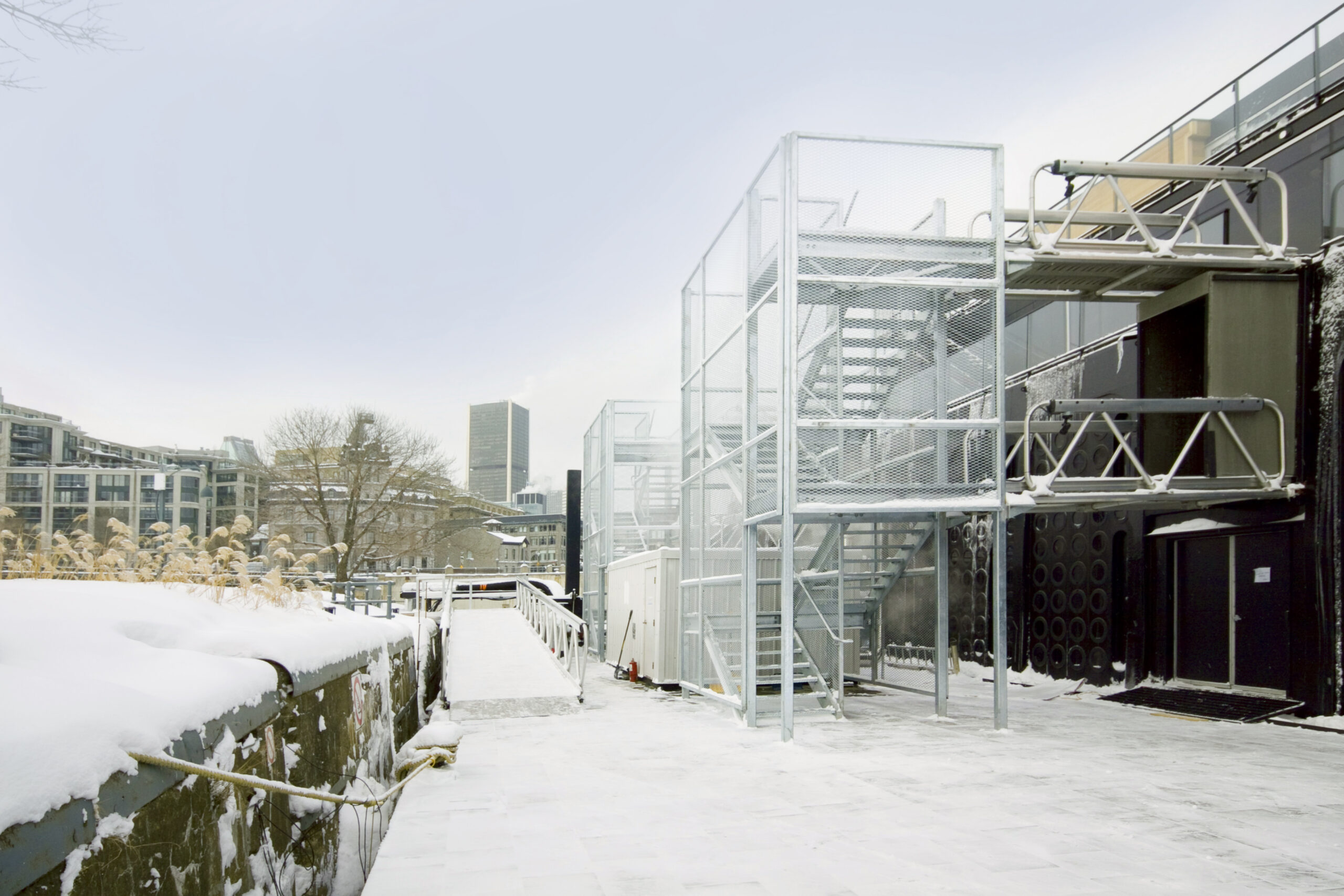
Installation of Five MakeABridge Gangways: A First for the MAADI Group
Owners of the world’s first floating spa, Bota Bota Spa-sur-l’eau, in Montreal’s Old Port, asked MAADI Group to design and build five pedestrian gangways to a 52-metre vessel given a new life as a high-end spa. The project price tag was some $100,000. These new MakeABridge® gangways have been in use since November 29, 2010. The build/design deal, which was signed on October 2, 2009, provided for the delivery and installation of five modular gangways by MAADI.
Encouraged by its initial successes, MAADI Group is targeting a large Canadian market share for considerable growth in this new build/design segment.